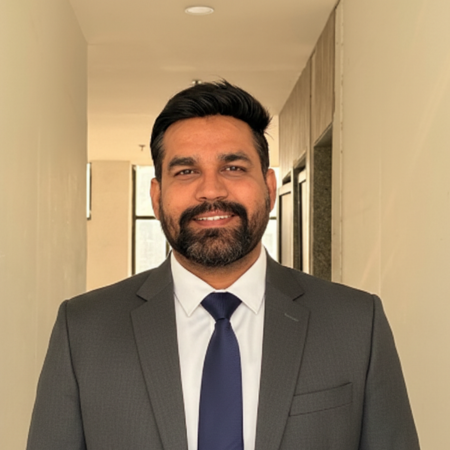
By Sahil Kataria, Chief Executive Officer, QServices
Updated June 12, 2026
Sahil Kataria is the CEO of QServices, a Microsoft Solutions Partner delivering AI agents and custom software for regulated industries. He leads enterprise AI strategy and FinTech delivery. LinkedIn ↗
Written from QServices' hands-on delivery work and reviewed by Rohit Dabra, Chief Technology Officer, QServices, before publishing.
QServices is a remote-first .NET development company serving Dallas businesses in FinTech, Healthcare, Telecom, and Logistics. We are not headquartered in Dallas; we work with Texas clients on remote engagements with a 2-hour CT-morning overlap daily. See our services overview.
What Dallas buyers typically need from .NET Development
Dallas is home to major financial services processors, large regional hospital systems, carrier networks, and one of the country's busiest freight and logistics hubs in the DFW corridor. The .NET projects we see in similar markets reflect those industries:
- FinTech payment and transaction APIs: High-throughput backends for payment processing, reconciliation engines, and audit trails built on .NET 8 and ASP.NET Core. The Texas Data Privacy and Security Act (TDPSA) and the Texas Department of Insurance (TDI) both require data handling controls that belong in the data model from day one, not added during a pre-launch compliance review.
- Healthcare data integrations and portals: EHR connectors, HIPAA-aware pipelines, and provider portals for hospital systems and health insurers. Any health insurance work in Texas falls under TDI oversight, which adds specific compliance documentation requirements to every delivery phase.
- Telecom provisioning and billing APIs: REST APIs managing subscriber records, provisioning workflows, and usage data at scale, typically on ASP.NET Core with Azure Service Bus for event-driven processing.
- Logistics and supply chain platforms: Real-time tracking APIs, warehouse management integrations, and route data feeds built on Entity Framework and SQL Server, serving the DFW logistics corridor.
For any project touching financial or health data in Texas, TDPSA obligations and TDI requirements belong in sprint one. Treating them as an afterthought adds weeks of rework and documentation before launch.
How we work with Dallas clients
Dallas runs on Central Time (CT). Our engineering team is in India on Indian Standard Time (IST). The gap is 10.5 hours during Central Daylight Time (CDT) in summer. When your team starts at 9:00 AM CT, it is 7:30 PM IST for us. We align our end of day to cover 9:00-11:00 AM CT for standups, sprint demos, and unblocking decisions. Questions raised before your lunch get answered before your close of business.
Outside that overlap window, work moves async. Pull requests go through GitHub with written review notes. Architecture decisions get a short recorded walkthrough. Sprint boards in Jira or Linear give your team full visibility between calls. We do not gate delivery on a live meeting.
On-site visits to Dallas are available for project kickoffs or production launches, billed at cost. Most engagements run fully remote without one.
Relevant work in similar markets
We do not have a published Dallas-based .NET client. The closest case studies are in FinTech payments, the largest tech sector in the DFW area.
Case Study
Mobile Payment Platform for SomBank (Somalia)
Islamic bank, Somalia
100K+ downloads with 4.8-star rating on launch
First digital payment platform in a predominantly cash-based economy, enabling P2P transfers, merchant QR payments, and international remittances
React Native.NETMySQLAzure Service BusAzure B2C
For SomBank, an Islamic bank in Somalia, our team built a mobile payment platform on .NET, Azure B2C, Azure Service Bus, and an Ocelot API Gateway. The platform launched with over 100,000 downloads and a 4.8-star rating, introducing P2P transfers, QR merchant payments, and international remittances to a predominantly cash-based economy. The API-first contracts, transaction audit trail, and identity management patterns we applied there map directly to FinTech and payments work in Texas.
Case Study
Cross-Border Payment Gateway Aggregator (Varipay / CoolPay)
International payments and remittance business, Jamaica
Reduced transaction fees by approximately 30 percent through optimized gateway routing
Cut settlement times from 3-5 days to under 24 hours with a unified reconciliation engine and audit trail
Microservices ArchitectureStripePayPalWiseRegional Gateways
For Varipay, a cross-border payment aggregator operating across Jamaica and other markets, we built a microservices gateway routing transactions through Stripe, PayPal, Wise, and regional processors. Transaction fees dropped by roughly 30 percent and settlement times fell from 3-5 days to under 24 hours through a unified reconciliation engine. See our full case study list for implementation detail.
Both engagements are in payments and FinTech, not Healthcare or Telecom. For those verticals in Dallas, we can walk through architecture references and relevant experience during a discovery call.
What .NET development costs for a typical Dallas project
We price in USD. Hourly rates run $20-$65 depending on seniority. Most project engagements fall into these brackets:
- Small scope ($2,000-$8,000): A focused API, data migration, or single service at 80-200 hours. Suitable for internal tools, targeted integrations, or proof-of-concept builds.
- Medium scope ($8,000-$30,000): A full backend service, admin portal, or multi-integration project at 200-600 hours.
- Large scope ($30,000-$120,000): A multi-service platform, ERP integration, or data-intensive application at 600-2,000 hours.
- Platform scope ($120,000-$400,000): Enterprise platforms with 2,000-plus hours, full CI/CD pipelines, and multi-environment deployments.
For HIPAA-scoped healthcare work or projects under TDI jurisdiction, add 15-25 percent for compliance controls and documentation. Each non-trivial third-party integration (EHR system, payment gateway, logistics API) adds $3,000-$12,000 to scope. See our .NET development pricing guide for a full breakdown.
How to start working with us
Three steps from first contact to project start:
- Discovery call (30-45 minutes): We talk through what you are building, your timeline, key integrations, and compliance requirements. We will tell you plainly if the engagement is not a fit.
- Scoping document: Within 5 business days we deliver a written scope with effort estimates, team composition, and a phased delivery plan.
- Project start: Once scope is agreed, we set up environments, communication channels, and the first sprint. Most projects start within two weeks of sign-off.
Can you work with Dallas companies remotely?
Yes. Dallas is CT (UTC-5 during CDT, UTC-6 during CST). Our India-based team is UTC+5:30. The live overlap for calls is 9:00-11:00 AM CT, which we protect for standups, demos, and urgent decisions. Day-to-day coordination runs through Slack or Microsoft Teams, with Jira for sprint tracking and GitHub for code review.
For projects under TDPSA, data residency is your decision and we build to your specified environment. We do not store client data outside your designated infrastructure. For healthcare or health insurance work under TDI oversight, HIPAA controls, audit logging, and security documentation are baseline requirements from sprint one, not optional line items.
Ready to discuss your project?
Share your requirements with QServices. Our engineers will give you a straight answer on fit, timeline, and cost — no sales scripts.
Book a Free Consultation
Frequently Asked Questions
Do you have an office in Dallas? +
No. QServices is remote-first and based in India. We work with Dallas clients during CT hours, with a daily overlap window of 9:00-11:00 AM CT for standups and reviews. There is no Dallas office, but the 10.5-hour timezone gap is manageable with a structured morning overlap and async tooling between calls.
What is the time difference between Dallas and your team? +
Dallas runs on Central Time (CT). Our team is on Indian Standard Time (IST), which is 10.5 hours ahead during CDT (summer) and 11.5 hours ahead during CST (winter). Your 9:00 AM CT is 7:30-8:30 PM IST, which is when we schedule standups, sprint demos, and urgent reviews.
Have you worked with .NET companies in Texas before? +
We do not have a published Texas-based client. Our closest .NET case studies are in FinTech payments: SomBank in Somalia (100,000-plus downloads, built on .NET and Azure) and Varipay in Jamaica (30 percent fee reduction, microservices architecture). The architecture patterns and API-first discipline apply directly to Dallas FinTech and Logistics work.
How do you handle data residency and privacy requirements for Texas clients? +
Data residency is your decision. We build to your specified environment and do not store client data outside your designated infrastructure. For TDPSA compliance, we implement required controls from the data model stage. For TDI-regulated health insurance work, HIPAA controls and audit logging are baseline requirements built in from sprint one.
What industries do you serve in the Dallas market? +
Our .NET work covers all four of Dallas's primary tech sectors: FinTech (payment APIs, reconciliation engines), Healthcare (EHR integrations, HIPAA-aware pipelines), Telecom (provisioning and billing APIs), and Logistics (tracking APIs, warehouse integrations). We have direct case study evidence in FinTech payments specifically.