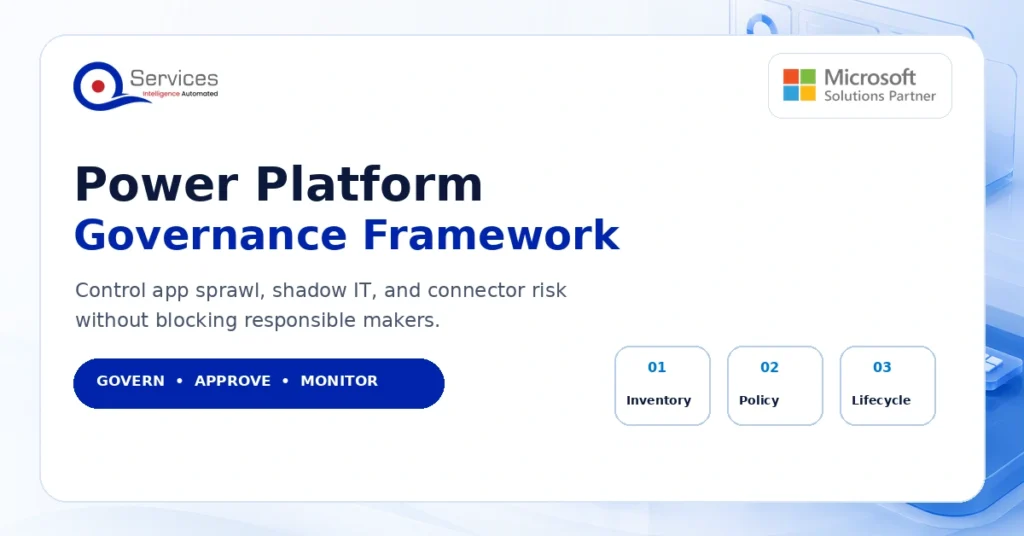
Power Platform governance for SMBs is one of those topics that sounds like enterprise IT overhead until you're knee-deep in 200 undocumented flows, three default environments with production data mixed in, and a licensing bill nobody can explain. By the time most small businesses realize they have a governance problem, the technical debt is already painful to untangle. This guide covers what governance actually means at an SMB scale, where technical debt starts forming, and what you can do today to stop it before it compounds into a real crisis.
What Power Platform Governance for SMBs Actually Means
Power Platform governance is the set of policies, processes, and tools that control how Power Apps, Power Automate, Power BI, and Copilot Studio are built, deployed, and maintained across your organization.
For enterprise companies, this usually means a full Center of Excellence team with dedicated staff. For an SMB with 20 to 200 employees, it means something more realistic: a documented environment strategy, a few enforced data policies, and clear rules for who can build what and where.
Most SMBs skip governance early because it feels like a barrier to the speed that makes low-code attractive. That logic makes sense for the first three months. After 12 months, it tends to collapse under its own weight as orphaned apps, mystery flows, and surprise licensing charges start accumulating.
According to Microsoft's Power Platform admin documentation, the default environment is shared across your entire tenant, which means any user with a Microsoft 365 license can start building and connecting to business data without any oversight by default.
Where Power Platform Technical Debt Actually Starts
Most Power Platform technical debt doesn't come from bad developers. It comes from good intentions with no guardrails.
Here's what the accumulation typically looks like in practice:
A sales manager builds a Power Automate flow to notify the team about new leads. It works well.
Six months later, there are 40 flows. Nobody knows which ones are still active. Three duplicate each other.
A developer leaves. Their flows keep running. Nobody holds the credentials they used to connect to Salesforce.
The default environment now contains real customer data because nobody ever set up a dedicated production environment.
Licensing costs jump because premium connectors got added without anyone reviewing the billing impact.
This pattern is common enough that Gartner research on low-code platform risks consistently flags ungoverned citizen development as the top risk in low-code adoption for organizations under 500 employees.
The cost side gets complicated fast. If you're unsure what you're actually paying for Power Platform today, review our breakdown of Power Platform licensing for SMBs in 2026 before adding more premium connectors to the mix.
The Real Cost of Poor Power Platform Governance
Numbers make this concrete. Consider a 50-person company that has been on Power Platform for 18 months with no governance in place:
Problem Area
Typical Impact
Duplicate flows
15-20% of flows doing redundant work
Orphaned apps
30-40% of apps unused but still consuming licenses
Security incidents
Average 2-3 DLP violations per quarter with no policies
Migration and cleanup effort
80-120 hours to audit and restructure 18 months of ungoverned builds
Unreviewed premium connector charges
$500-$2,000/month in billing surprises
The 80-120 hour cleanup estimate is conservative. Some companies spend closer to 200 hours untangling environments before they can confidently deploy a new business-critical app. That's the hidden tax of skipping governance at the start.
Setting Up Your Environment Strategy for Power Platform Governance
Environment strategy is where Power Platform governance for SMBs should start. Get this right first and everything else is easier to enforce.
The Default Environment Problem
Every Microsoft tenant gets a default environment automatically, and it's wide open. Any licensed user can create apps and flows there. There's no separation between what's being tested and what's running production processes. If a developer accidentally connects a flow to live customer data during testing, there's nothing stopping it.
The fix is straightforward but requires someone to actually implement it:
Rename and restrict the default environment. Keep it for personal productivity experiments only, not business apps.
Create dedicated environments for development, testing, and production.
Restrict who can create apps in the production environment. Require a review step before promotion.
Enable environment-level data policies before any production work begins.
Recommended SMB Environment Topology
For most SMBs, three environments is the right starting point:
Development: Open access for builders. No real customer data. Sandbox connectors only.
UAT/Testing: Restricted access. Anonymized or synthetic data for testing realistic scenarios.
Production: Locked down. Managed by IT or a designated Power Platform admin. All changes go through a review step.
This is lighter than what a large enterprise runs, but it's enough to prevent the worst failure modes. You can always add environments as you grow. Starting with more structure than you think you need is far easier than retrofitting it after 18 months of unmanaged growth.
Eager to discuss about your project?
Share your project idea with us. Together, we’ll transform your vision into an exceptional digital product!
With environments sorted, the next layer is policies and tooling. These are the practices that make governance an ongoing standard rather than a one-time cleanup project.
Data Loss Prevention Policies
Data loss prevention (DLP) policies control which connectors can be used together and how data flows between them. They're configured at the tenant or environment level in the Power Platform admin center.
For an SMB, start with two tiers:
Business tier: Connectors that can touch core business data (SharePoint, Dynamics 365, SQL Server, Teams)
Non-business tier: External connectors that should never touch internal data by default (personal email, public social APIs, unapproved third-party services)
Microsoft provides built-in classification for most connectors. Your job is to review the defaults and adjust them to match your actual risk tolerance. A fintech SMB handling payment data needs tighter DLP policies than a marketing agency. If you're in financial services, the overlap with compliance requirements is significant, and it's worth reading how digital workflow automation for banking handles data classification at that level.
Naming Conventions and Documentation
This sounds obvious but almost nobody does it consistently from day one. Enforce naming conventions for flows, apps, and connections before bad habits form:
Prefix apps by department: HR_, FIN_, OPS_
Include the owner's name or team in the description field
Tag flows with their business process: Invoice_Approval, New_Employee_Onboarding
Without naming conventions, a list of 80 flows in the Power Automate admin center is unreadable. With them, you can audit the full environment in under 30 minutes.
Licensing Cost Controls
Premium connectors and Power Apps per-user plans are the most common sources of surprise charges. Set a policy that any flow using a premium connector requires IT sign-off before going live. The per-user cost adds up quickly when citizen developers add SQL or Salesforce connections without checking the billing impact first.
Managing Citizen Developers Without Losing Control
Citizen developer governance is where the human side of Power Platform administration gets real. The goal isn't to stop people from building. It's to channel that energy into work that's maintainable and secure.
The approach that works best in practice:
Train before you grant access. A 90-minute internal session covering environment rules, naming conventions, and which connectors need approval prevents about 70% of governance problems. Most citizen developers aren't trying to break anything; they just don't know the rules exist.
Use the maker portal to track activity. The Power Platform admin center shows you which environments are active, who's building, and which apps haven't been opened in 90 days. Review this monthly. Delete stale apps after giving owners 30 days notice.
Create a connector request process. When someone needs a premium connector or a new external integration, they submit a simple form. This creates a paper trail, triggers a license check, and gives IT a chance to suggest a better approach if one exists.
For SMBs also managing broader automation, the same principles apply to Power Automate for SMBs. Flow sprawl prevention and citizen developer governance are two sides of the same problem, and solving one without the other doesn't stick.
Eager to discuss about your project?
Share your project idea with us. Together, we’ll transform your vision into an exceptional digital product!
The Power Platform Center of Excellence Starter Kit
The Power Platform CoE Starter Kit is Microsoft's free governance toolkit. It's a collection of Power Apps, flows, and dashboards that give you visibility across your entire tenant without building anything custom.
For SMBs, the most useful components are:
Inventory dashboard: Automatically catalogs every app, flow, and maker across all environments
Compliance process: Sends automated emails to app owners asking them to document their apps and confirm they're still needed
Risk assessment: Flags apps using premium connectors or connecting to sensitive data sources
The honest tradeoff: the CoE Starter Kit takes 4-8 hours to set up properly, and it requires at least one person comfortable in Power Platform to maintain it. For a company under 30 employees, it might be more than you need right now. For 50 to 200 employees, it's worth the setup cost because it replaces manual auditing entirely.
Install it in a dedicated CoE environment. Do not install it in your production or default environment.
When to Move from Power Apps to Custom Development
This decision comes up for most SMBs that have been on Power Platform for 2 to 3 years. At some point, the platform's limitations start creating more technical debt than the speed benefits justify.
The signals that indicate it's time to consider custom .NET development:
Your app has more than 500 active users and performance is degrading noticeably
You need complex offline functionality that Power Apps can't handle reliably
Your data model has grown beyond what Dataverse handles cleanly at your scale
You're spending more on Power Apps premium licensing than a custom app would cost to build and maintain
Your compliance requirements need audit controls that aren't available within the platform
The decision isn't binary. Many SMBs run Power Apps for internal tooling and custom apps for customer-facing products. If you're at that crossroads, our comparison of no-code vs low-code vs custom software walks through the five factors that actually matter for the decision.
The cost math is worth running carefully. A Power Apps per-user plan at $20/user/month for 100 users is $2,000/month or $24,000/year. A custom app might cost $40,000 to $60,000 to build but nothing in per-seat licensing afterward. The break-even point is usually 2 to 3 years, assuming the app scope stays relatively stable.
Governance Is Cheaper Than Cleanup
The work of setting up Power Platform governance for SMBs is front-loaded. You spend time building environment structure, writing DLP policies, and training makers before any of those things feel necessary. That's exactly why most teams skip it.
But the cleanup cost compounds faster than most teams expect. What takes 4 hours to set up correctly in month one takes 100 hours to untangle in month 18. The technical debt doesn't just slow you down; it creates real security exposure when undocumented flows are connecting to production data with credentials nobody actively manages.
If you've already accumulated debt, start with an environment audit. Export a full inventory of your apps and flows using the CoE Starter Kit or the Power Platform admin center, identify orphaned and duplicate items, and establish the three-environment structure before building anything new. Everything else can follow in phases.
For teams mapping the broader automation picture, it also helps to understand where Power Platform fits alongside other Azure-native tools. Our guide on Power Automate vs Logic Apps vs Dynamics 365 covers when to reach for each tool, which matters once your governance structure is in place and you're making deliberate decisions about where new workflows live.
Conclusion
Power Platform governance for SMBs doesn't need to be enterprise-grade to be effective. A clear environment strategy, a few DLP policies, naming conventions, and monthly admin reviews cover 90% of the risk for most small businesses. The Power Platform CoE Starter Kit handles the visibility layer without requiring a dedicated governance team.
Start with environments and DLP policies this week. Add the CoE Starter Kit within the next 30 days. Train your citizen developers before they build, not after they've created a mess that takes months to clean up. The overhead is real but it's a fraction of what ungoverned growth costs later.
If you're not sure where your platform stands today, we can run a Power Platform governance audit and build a roadmap specific to your organization's size and risk profile. Contact us to start that conversation.
Co-Founder and CTO, QServices IT Solutions Pvt Ltd
Rohit Dabra is the Co-Founder and Chief Technology Officer at QServices, a software development company focused on building practical digital solutions for businesses. At QServices, Rohit works closely with startups and growing businesses to design and develop web platforms, mobile applications, and scalable cloud systems. He is particularly interested in automation and artificial intelligence, building systems that automate routine tasks for teams and organizations.
Power Platform governance is the combination of policies, processes, and tools that control how Power Apps, Power Automate, Power BI, and Copilot Studio are built and maintained across your organization. For SMBs it matters because without governance, the default environment is open to all licensed users, which leads to orphaned flows, mixed production and test data, unreviewed premium connector charges, and security vulnerabilities from unmanaged credentials. Most SMBs hit a governance crisis around 12 to 18 months into their Power Platform adoption.
Preventing Power Platform technical debt starts with three practices: setting up separate development, testing, and production environments before building anything, enforcing DLP policies that restrict which connectors can access business data, and requiring that citizen developers follow naming conventions and document their flows. Monthly audits using the Power Platform admin center help catch orphaned or duplicate flows before they accumulate. The CoE Starter Kit automates most of this auditing work once it’s installed.
The Power Platform CoE Starter Kit is a free governance toolkit from Microsoft that includes pre-built Power Apps, Power Automate flows, and dashboards. It automatically inventories every app, flow, and maker across all environments in your tenant, sends compliance check-ins to app owners, and flags high-risk apps using premium connectors or sensitive data sources. For SMBs with 50 or more employees, it typically replaces 8 to 10 hours of manual monthly auditing. Setup takes 4 to 8 hours and it should be installed in a dedicated CoE environment.
An SMB should consider moving from Power Apps to custom .NET development when the app has more than 500 active users and performance is degrading, when offline functionality requirements exceed what Power Apps supports, when compliance audit controls aren’t available within the platform, or when per-user licensing costs exceed what a custom-built app would cost over a 2 to 3 year horizon. Many SMBs keep Power Apps for internal tooling while moving customer-facing products to custom development.
The most effective approach is to train citizen developers before granting access rather than after problems appear. A 90-minute internal session covering environment rules, naming conventions, and which connectors require IT approval prevents the majority of governance issues. Beyond that, use the Power Platform admin center to monitor maker activity monthly, delete apps that haven’t been opened in 90 days after giving owners notice, and require a connector request form for any premium or external integration.
The most common mistakes are: using the default environment for production apps (which mixes all users and all data together), adding premium connectors without checking licensing costs, not setting DLP policies before citizen developers start building, failing to document app ownership so nobody knows who to contact when something breaks, and skipping the CoE Starter Kit because setup feels expensive upfront. All of these are cheap to prevent and expensive to fix after 12 to 18 months of growth.
Start by renaming and restricting the default environment to personal productivity use only. Then create three dedicated environments: development (open access, no real data, sandbox connectors), UAT or testing (restricted access, anonymized data), and production (locked to IT-managed deployments only). Apply DLP policies to each environment before any business apps go live. This three-environment setup takes 2 to 4 hours to configure and prevents the most common technical debt and security issues.
Business intelligence consulting services should give a mid-market company a governed way to make decisions. Attractive dashboards are only the visible part. The useful outcome is a system in which source data, metric definitions, access, releases, ownership, and support still work after the consultants leave.
In a Microsoft Solutions Partner vs Microsoft Partner comparison, the difference is validation. A company can participate in the Microsoft AI Cloud Partner Program without holding a customer-facing Solutions Partner designation. A designated Solutions Partner has met Microsoft’s current threshold in a specific solution pathway: at least 70 out of 100 partner capability points, with more than zero points in every required metric, based on performance, skilling, and customer success data recorded in Partner Center.
Business intelligence consulting services should give a mid-market company a governed way to make decisions. Attractive dashboards are only the visible part. The useful outcome is a system in which source data, metric definitions, access, releases, ownership, and support still work after the consultants leave.
In a Microsoft Solutions Partner vs Microsoft Partner comparison, the difference is validation. A company can participate in the Microsoft AI Cloud Partner Program without holding a customer-facing Solutions Partner designation. A designated Solutions Partner has met Microsoft’s current threshold in a specific solution pathway: at least 70 out of 100 partner capability points, with more than zero points in every required metric, based on performance, skilling, and customer success data recorded in Partner Center.