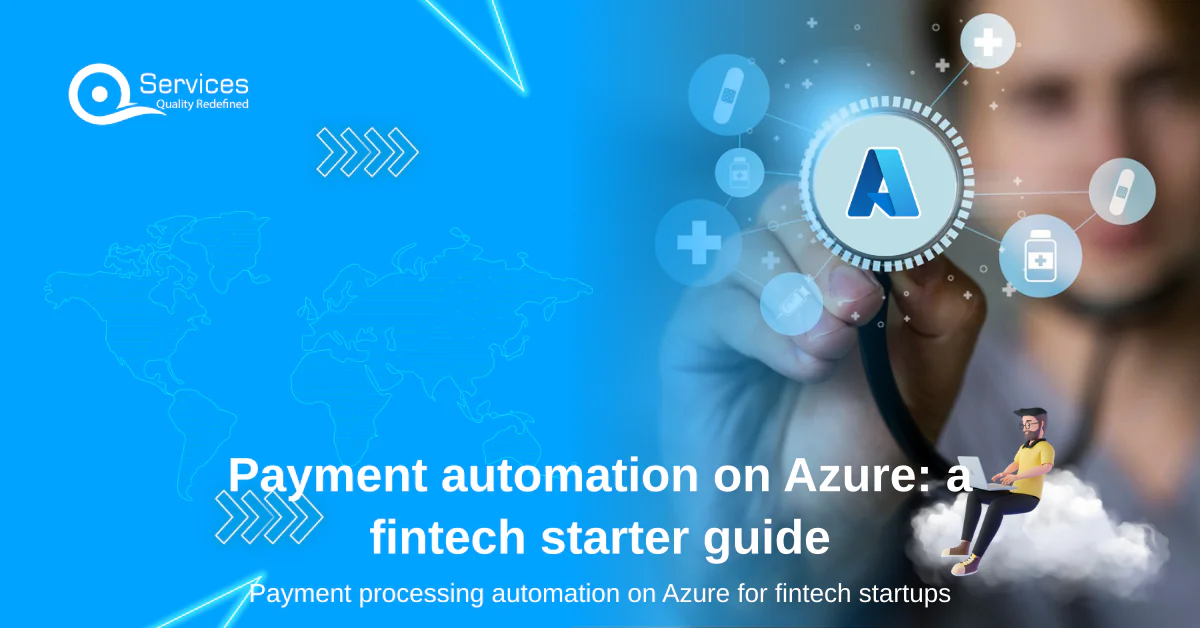
Payment processing automation on Azure for fintech startups is no longer just an enterprise play. Teams with five engineers and a modest cloud budget can now build PCI-DSS compliant payment pipelines on Azure without the six-figure consulting engagements that once made this feel out of reach. The honest caveat: getting this right still takes planning. The tools are accessible, but wiring them together incorrectly creates compliance gaps that regulators notice. This guide walks through the Azure services that matter, how PCI-DSS compliance maps to those services, and where startups consistently run into trouble. The architecture principles apply equally to subscription payments, marketplace disbursements, and gig economy payouts.
Why Azure Makes Sense for Fintech Payment Automation
Microsoft Azure holds a PCI-DSS Level 1 Service Provider certification, which is the highest level of payment card industry compliance available. When you build on Azure, a large portion of the infrastructure-level PCI-DSS controls are already satisfied by Microsoft. You inherit those controls rather than build them from scratch.
This matters for startups because the alternative is painful. Standing up a PCI-compliant data center requires a Qualified Security Assessor (QSA) audit, physical security documentation, network segmentation proof, and ongoing monitoring costs that realistically run $50,000 to $200,000 per year before you have processed a single transaction. Azure's shared responsibility model cuts that burden significantly, though it does not eliminate it entirely.
The honest tradeoff: Azure gives you compliant infrastructure, but you still own application-level controls. That means your tokenization logic, your API authentication, your logging, and your encryption key management all remain your responsibility. Startups most often stumble on those application-level gaps, not the infrastructure ones.
Core Azure Services for Payment Processing Automation on Azure for Fintech Startups
Not every Azure service belongs in a payment automation stack. The ones below are the ones that actually show up in production fintech architectures.
Azure API Management
Every payment workflow starts with an API call, usually to a third-party gateway like Stripe, Adyen, or Braintree. Azure API Management (APIM) sits in front of those calls and enforces rate limiting, IP filtering, authentication, and request logging in one place. For a startup, this replaces what would otherwise be custom middleware code scattered across multiple services.
APIM also gives you a single audit trail for all payment API calls, which is exactly what PCI-DSS Requirement 10 (audit logs) needs. You get that almost for free rather than building a custom logging layer.
Azure Key Vault
Payment tokenization requires encryption keys, and those keys need to be stored somewhere secure that is not your application code or a config file. Azure Key Vault handles key storage, rotation, and access control. It integrates directly with most Azure services, so your payment processing functions can retrieve secrets at runtime without ever storing them in environment variables.
For startups handling card data, the Azure Payment HSM is worth knowing about. It is a dedicated hardware security module for payment-specific cryptographic operations with FIPS 140-2 Level 3 certification. It is overkill for most early-stage startups, but if you are processing card-present transactions or operating as a payment processor, it becomes relevant quickly.
Azure Logic Apps
Logic Apps is the orchestration layer that connects payment events to downstream actions: a payment succeeds, triggering an invoice generation, a fulfillment notification, and a reconciliation record update, all automatically. You define the workflow visually, and Logic Apps handles retry logic, error handling, and execution history.
Azure Functions
For custom business logic that Logic Apps cannot handle declaratively, Azure Functions fills the gap. Processing fee calculations, dynamic routing between payment gateways, and fraud scoring calls all work well as Functions. They scale to zero when idle, which matters for startups watching their monthly bill.
Azure Service Bus
Payment workflows fail. Gateways time out. Networks hiccup. Azure Service Bus provides the message queue that prevents those failures from causing duplicate charges or lost transactions. Every payment event should go through a durable message queue before any processing happens. This is a step many startups skip early on and regret when they hit their first production incident.
PCI-DSS Compliance on Azure: What You Actually Need to Know
PCI-DSS compliance is not a product you buy. It is a set of 12 requirement groups that you demonstrate through documentation, technical controls, and periodic assessments. Azure satisfies many of the infrastructure requirements, but several remain yours to address.
The PCI Security Standards Council publishes the full standard, and reading Requirement 3 (stored cardholder data) and Requirement 6 (secure system development) is worth an hour of your time before you write a line of code.
Here is what Azure handles automatically when you use compliant services:
- Physical data center security (Requirement 9)
- Network infrastructure hardening (parts of Requirements 1 and 2)
- Infrastructure-level vulnerability management (parts of Requirement 6)
- Data center access logging (parts of Requirement 10)
Here is what you must handle yourself:
- Tokenization: Never store raw card numbers. Use your payment gateway's tokenization (Stripe tokens, Adyen tokens) and store only the token in your database.
- Encryption in transit: Enforce TLS 1.2 or higher on all endpoints. Azure makes this straightforward via App Service and APIM policy settings.
- Access control: Follow least-privilege principles. No developer should have production access to payment data. Use Azure Active Directory role-based access control.
- Logging and monitoring: Azure Monitor and Microsoft Sentinel can cover most of Requirement 10, but you need to configure retention periods (12 months minimum) and alert rules manually.
- Vulnerability scanning: Run ASV scans quarterly. Several Azure Marketplace partners offer this as a managed service for under $500/month.
For teams that want a deeper look at compliance automation on Azure, How to Automate Banking Compliance on Azure covers the monitoring and alerting configuration in detail. And if you are new to the broader security posture required, Azure Cloud Security for SMBs: 7 Proven Practices gives a solid baseline to build from.
Eager to discuss about your project?
Share your project idea with us. Together, we’ll transform your vision into an exceptional digital product!
Book an Appointment now
Building a Payment Automation Workflow on Azure: Step by Step
This is the part most guides skip: the actual build sequence. Here is a realistic order of operations for a startup standing up its first payment automation pipeline on Azure.
Step 1: Scope your cardholder data environment (CDE)
Before writing any code, draw a boundary around exactly which systems will touch payment data. The smaller the CDE, the smaller your compliance audit surface. Use Azure Virtual Networks to segment payment workloads from everything else in your environment.
Step 2: Configure Azure API Management as your payment gateway proxy
Set up APIM as the single entry point for all calls to your payment gateway. Configure policies for:
- OAuth 2.0 authentication on inbound requests
- Rate limiting (start with 100 requests per minute per client)
- Request logging to a dedicated Log Analytics workspace
Step 3: Set up Azure Key Vault with managed identity access
Create a Key Vault in your CDE resource group. Grant your Azure Functions and Logic Apps access via managed identities, not stored credentials. This means your code never handles a secret string directly.
Step 4: Build your core Logic Apps workflow
A minimal payment processing workflow in Logic Apps follows this sequence:
- Receive webhook from payment gateway (Stripe, Adyen, etc.)
- Validate the webhook signature using a Function call to Key Vault
- Write the payment event to Service Bus
- Trigger downstream actions: update database, generate receipt, send notification
Step 5: Add error handling and dead letter queues
Configure Service Bus dead letter queues for failed messages. Set up alerts in Azure Monitor that fire when the dead letter queue depth exceeds five messages, a reasonable starting threshold. Every failed payment event should be reviewable and replayable without data loss.
Step 6: Configure audit logging
Route all Logic Apps and APIM logs to a Log Analytics workspace with a 12-month retention policy. Create alert rules for unusual patterns: more than three failed authentication attempts in five minutes, payment amounts outside normal ranges for your business, or sudden spikes in webhook volume.
The How to Automate SMB Compliance Using Azure Logic Apps guide covers Step 6 in much more depth, including the specific KQL queries that work best for payment audit logs.
Azure Logic Apps vs. Power Automate: Choosing the Right Tool
This is a question we see constantly from fintech startups, and the honest answer is that they target different use cases despite sharing a visual workflow builder.
| Feature |
Azure Logic Apps |
Power Automate |
| Primary user |
Developers |
Business analysts |
| Hosting |
Azure (dedicated or consumption tier) |
Microsoft 365 / Power Platform |
| Custom connectors |
Full support |
Supported, but limited |
| PCI-DSS suitability |
High (runs inside your Azure CDE) |
Lower (data may leave your CDE) |
| Cost model |
Per execution or dedicated tier |
Per user license |
| Best for |
Core payment processing orchestration |
Internal notifications, reporting |
For the actual payment processing pipeline, Logic Apps is the right choice. Power Automate is better for the surrounding business processes: notifying your finance team when a batch reconciliation completes, generating weekly payment volume summaries, or triggering a CRM update when a subscription renews.
If you are exploring what Power Automate can do for your broader operations, 5 Power Platform Low-Code Solutions for SMBs covers practical use cases that pair well with a Logic Apps payment core.
Eager to discuss about your project?
Share your project idea with us. Together, we’ll transform your vision into an exceptional digital product!
Book an Appointment now
Managing Costs Without Sacrificing Compliance
This is where startups feel the most pressure, and where the most unnecessary spending happens. A well-architected Azure payment automation stack for an early-stage startup can run under $300/month for moderate transaction volumes (up to 50,000 transactions per month).
Here is a realistic monthly cost breakdown:
| Service |
Tier |
Estimated Monthly Cost |
| Azure API Management |
Developer tier |
$50 |
| Azure Logic Apps |
Consumption plan |
$20-$80 |
| Azure Functions |
Consumption plan |
$0-$30 |
| Azure Key Vault |
Standard |
$5-$15 |
| Azure Service Bus |
Standard |
$10-$25 |
| Azure Monitor / Log Analytics |
Pay-as-you-go |
$30-$100 |
| Total |
|
$115-$300 |
The big savings opportunity is the Logic Apps consumption model. You pay per execution rather than running a dedicated instance, which works well for startup transaction volumes. As you scale past 500,000 transactions per month, the dedicated tier starts making financial sense.
For the broader cost management picture, the strategies in 7 Azure Cost Optimization Tips for Startups in 2026 apply directly to payment infrastructure, particularly the guidance on resource tagging and budget alerts.
The one place not to cut costs: Azure Monitor log retention. Dropping retention below 12 months is a PCI-DSS violation. The $30-$100/month for Log Analytics is not optional.
Fraud Detection Inside Your Payment Automation Pipeline
Payment automation without fraud detection is incomplete. Azure offers two practical options for startups that do not have a dedicated data science team.
Azure Fraud Protection is Microsoft's managed fraud detection service, built on signals from the Microsoft transaction network. It integrates into payment workflows via a single API call and returns a fraud score within milliseconds. Pricing starts at roughly $0.001 per event, which is negligible at early transaction volumes.
Azure Machine Learning is the right path if you have proprietary transaction data and want a custom fraud model. Training on your specific transaction patterns catches fraud that generic models miss, but it requires data volume (typically 100,000 or more labeled transactions) and ML engineering time. Most startups should start with Azure Fraud Protection and move to custom models once they have enough data to train on.
For both options, the integration pattern is the same: add a Function call to your Logic Apps workflow that hits the fraud detection API before the payment is authorized. If the fraud score exceeds your threshold (typically 0.7 on a 0-1 scale), route the transaction to a manual review queue rather than blocking it outright. Automatic blocks generate too many false positives at startup transaction volumes and create customer experience problems you do not want in your early growth phase.
Conclusion
Payment processing automation on Azure for fintech startups is genuinely achievable without enterprise-scale budgets or a 20-person compliance team. The path is more straightforward than most guides suggest: use Azure's existing PCI-DSS compliance inheritance to cover infrastructure controls, build your payment orchestration with Logic Apps, protect your keys with Key Vault, and log everything to Monitor with a 12-month retention policy.
The realistic timeline for a first production-ready pipeline is 8 to 12 weeks: two weeks for CDE scoping and architecture, four to six weeks for the Logic Apps and Functions build, and two to four weeks for security review and QSA assessment preparation.
Start with consumption-tier services to keep your initial spend under $300/month, and add Azure Fraud Protection from day one. The cost is negligible and the protection is real. If you want a hands-on partner for the build, reach out to our team. We have built Azure payment pipelines for fintech startups across payments, lending, and insurance, and we can get you to a production-ready, PCI-DSS compliant system faster than going it alone.

Written by QServices Team
Co-Founder and CTO, QServices IT Solutions Pvt Ltd
Rohit Dabra is the Co-Founder and Chief Technology Officer at QServices, a software development company focused on building practical digital solutions for businesses. At QServices, Rohit works closely with startups and growing businesses to design and develop web platforms, mobile applications, and scalable cloud systems. He is particularly interested in automation and artificial intelligence, spending time experimenting with tools and building systems that automate routine tasks. Through his writing and projects, he explains practical ways to use modern technologies such as AI agents, automation platforms, and cloud-based systems in real business scenarios.
Talk to Our Experts
Frequently Asked Questions
Related Topics
Eager to discuss about your project?
Share your project idea with us. Together, we’ll transform your vision into an exceptional digital product!
Book an Appointment now