Deciding to outsource app development is one of the most consequential calls a startup founder makes. Get it right and you can ship a production-ready product in months, at a fraction of the cost of building an in-house team. Get it wrong and you end up with a half-finished codebase, missed deadlines, and a vendor relationship that is painful to exit. Outsourcing app development for startups is not a shortcut, it is a strategy that requires deliberate planning, the right partner, and a clear understanding of what you are handing off. This guide covers everything founders need to know in 2026, from vetting vendors and protecting IP to managing remote teams and understanding realistic costs.
Why Startups Are Turning to App Development Outsourcing in 2026
The economics are compelling. Hiring a senior full-stack developer in the US or UK now costs $130,000–$180,000 per year in salary alone, before benefits, equipment, and recruiting fees. An outsourced team in Eastern Europe, South Asia, or Latin America can deliver comparable output at 40–60% of that cost.
But cost is only part of the story. The bigger driver in 2026 is speed. Investors expect startups to move fast, and building an in-house team from scratch can take 6–9 months just to reach full productivity. An established software outsourcing company can often start sprint one within two weeks of contract signing.
There is also the talent access argument. Niche skills, Flutter mobile development, Azure cloud architecture, .NET microservices, are genuinely hard to find locally in many markets. App development outsourcing opens up a global pool of specialists rather than limiting you to whoever is job-hunting in your city this quarter.
Outsourcing vs. In-House App Development: What the Numbers Say
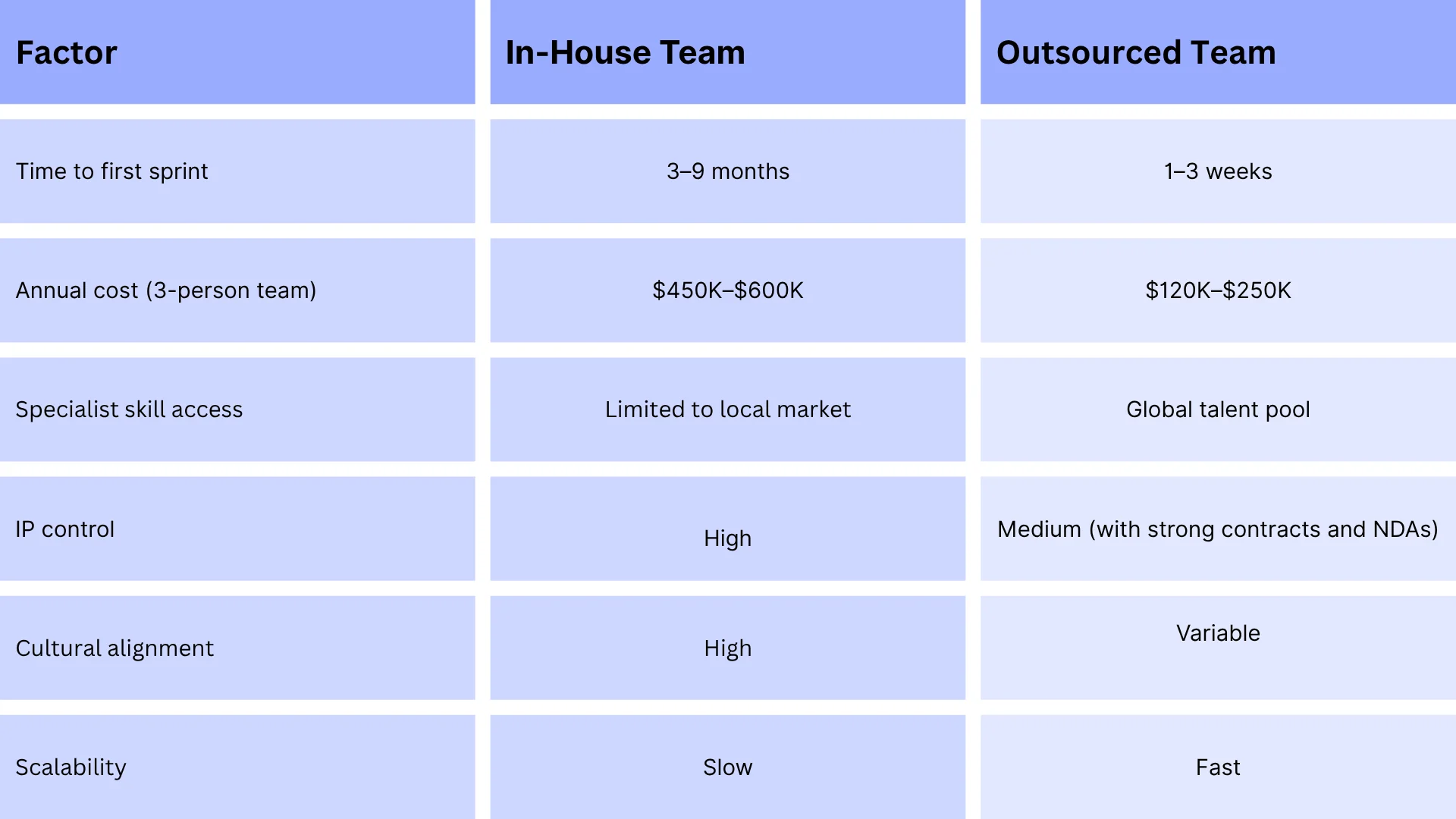
Before committing to either path, founders should run the actual numbers for their situation. Here is a simplified comparison:
The in-house route makes sense when you have a validated product, consistent engineering work, and the capital to build a culture around it. For most early-stage startups, especially those testing an MVP or iterating rapidly on product-market fit, outsourcing is the faster, leaner path.
One thing worth noting: the choice is rarely permanent. Many successful startups outsource to build their v1, then bring development in-house once they have raised a Series A and know exactly what they need. Thinking of it as “outsource now, hire later” removes a lot of the anxiety from the decision.
What to Know Before Outsourcing App Development
Most failed outsourcing projects share the same root causes: vague requirements, mismatched expectations, and no clear ownership of technical decisions. Getting ahead of these issues before you sign a contract is the real work.
Define Your MVP Scope First
Outsourced teams price and plan based on requirements. If your requirements are fuzzy, estimates will be too, and scope creep will eat your budget before you hit beta.
Before approaching any vendor, document:
The core user journeys your app must support at launch
The platforms you are targeting (iOS, Android, web, or all three)
Any third-party integrations required at day one (payment processors, identity providers, CRMs)
Your non-negotiable technical constraints (cloud provider, compliance requirements, data residency rules)
This does not require a full product spec. A clear, prioritized list of must-have vs. nice-to-have features is enough to get accurate proposals from serious vendors.
Choose the Right Engagement Model
There are three main models for outsourcing app development:
Fixed-price: You define the full scope upfront and pay a set amount. Good for well-defined, short projects. Risky for anything complex because vendors will cut corners to protect margin if scope shifts.
Time and materials: You pay for hours worked. More flexible, but requires active oversight to avoid runaway costs.
Dedicated team / staff augmentation services: You hire dedicated developer capacity that works as an extension of your team. Best for ongoing product development where requirements evolve.
For most startups building a custom app, a dedicated team model or a hybrid approach (fixed discovery phase, then time and materials) tends to work best.
How to Choose the Right App Development Outsourcing Company
This is where founders lose the most time. There are thousands of app development outsourcing vendors, and the difference between a great partner and a difficult one is not always obvious from a website or a sales call.
Look Beyond Portfolio Slides
Every agency has a polished portfolio. The questions that actually matter are:
Can you speak directly with past clients, not just read testimonials?
How do they handle a project that goes over budget or timeline?
What is their process when requirements change mid-sprint?
Who is the actual team that will work on your project, and how senior are they?
Ask to see a sample sprint board or project retrospective. A vendor that cannot or will not show you how they actually work is a vendor to avoid.
Assess Technical Stack Alignment
If you are building on Azure, your outsourcing partner should have demonstrable Azure experience, not just a checkbox on their services page. The same applies to specific frameworks. If your mobile app needs React Native or Flutter, ask for code samples and have a technical advisor review them.
For startups in the financial services space, stack alignment goes deeper. You need a team that understands regulated environments, knows what PCI-DSS or GDPR compliance looks like at the code level, and has shipped production software in those contexts before. A generalist agency that “has done fintech projects” is very different from a team that has built KYC workflows or payment processing pipelines from scratch.
If you are building on the Microsoft stack, look for vendors with verifiable Microsoft Solutions Partner status. Understanding what it means to be a Microsoft Solutions Partner gives you a clear picture of the technical benchmarks and accountability that certification requires.
Eager to discuss about your project?
Share your project idea with us. Together, we’ll transform your vision into an exceptional digital product!
Best Countries for Outsourcing App Development in 2026
Location still matters, even in a remote-first world. Time zone overlap, communication style, and cultural alignment all affect day-to-day productivity in ways that are easy to underestimate before a project starts.
Here is a practical breakdown of the top regions:
Eastern Europe (Poland, Ukraine, Romania, Bulgaria)
Strong engineering culture, high English proficiency, good time zone overlap with Western Europe, and competitive rates. Many Ukrainian developers now operate from Poland or other EU countries. Rates typically run $45–$85/hour for senior engineers.
South and Southeast Asia (India, Vietnam, Philippines)
India remains the largest outsourcing market by volume. Costs are the lowest ($25–$55/hour for senior developers), but time zone gaps with North American teams require structured async communication. Vietnam and the Philippines offer a middle ground on both cost and time zone overlap.
Latin America (Colombia, Mexico, Argentina, Brazil)
The fastest-growing outsourcing region for US-based startups in 2026, largely because of real-time zone alignment with North American teams. Rates are $40–$75/hour. Argentina in particular has produced strong mobile and cloud development talent.
Near-shore Western Europe (Portugal, Spain)
More expensive ($70–$110/hour) but easier to collaborate with UK and Central European teams. A good fit for startups that prioritize minimal communication friction over maximum cost savings.
How to Protect Your IP When Outsourcing App Development
IP protection is the concern founders raise most often, and it is legitimate. But the risk is manageable with the right contracts and operational habits.
At minimum, your outsourcing agreement should include:
IP assignment clause: All code, designs, and intellectual property created during the engagement are assigned to your company upon payment, not retained by the vendor.
Non-disclosure agreement (NDA): Signed before any project details are shared, covering all team members who will have access to your codebase.
Non-compete clause: Limits the vendor's ability to work on direct competitors for a defined period.
Source code access: You should always have access to the live repository throughout the project, not just at delivery.
Beyond contracts, practical habits help. Do not share more than the vendor needs to know. Use separate credentials for every integration, and audit access permissions regularly. If you are working in a regulated industry, your approach to identity and access management should be defined before your outsourced team writes a single line of code.
Managing a Remote Outsourced Development Team
Signing a contract is step one. Getting consistent, high-quality output from a remote team is an ongoing management job.
A few practices that consistently work:
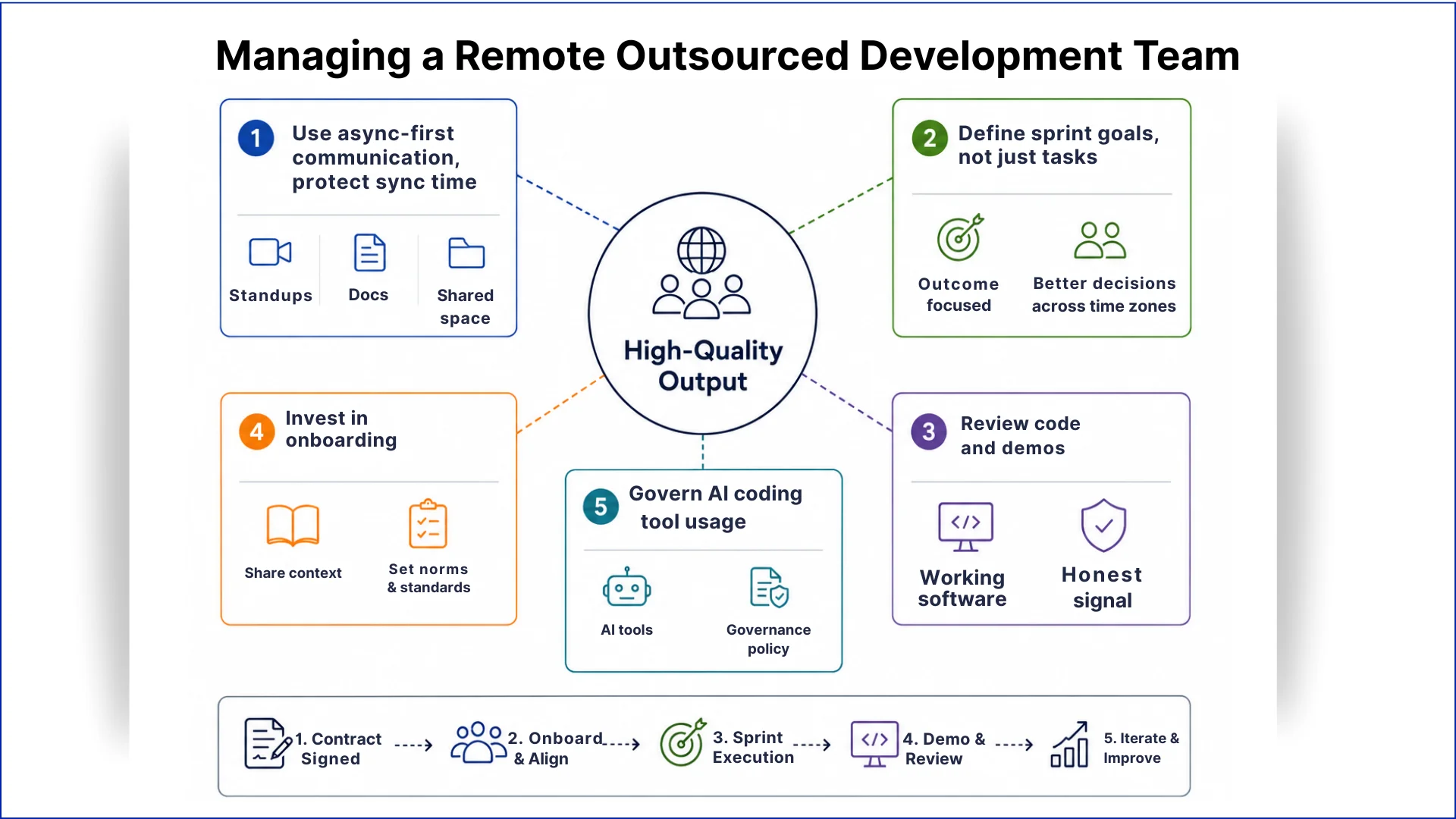
Use async-first communication, but protect sync time. Daily standups in a shared video call, even just 15 minutes, prevent the drift that kills remote projects. Everything else, feedback, documentation, requirements, should be written and stored where everyone can find it.
Define sprint goals, not just tasks. When an outsourced team understands the outcome they are driving toward (not just the ticket they are closing), they make better decisions about edge cases and tradeoffs. This matters especially when your team is eight time zones away.
Review code and demos, not just reports. Status updates can be optimistic. Working software in a staging environment is an honest signal. Require a working demo at the end of every sprint, no exceptions.
Invest in onboarding. The first two weeks with a new outsourced team set the tone for the entire engagement. Share your roadmap, architecture decisions, coding standards, and communication norms upfront. Vendors who are well-onboarded produce better work and ask fewer disruptive questions later.
It is also worth thinking about tooling. Teams that rely on AI coding assistants are becoming the norm. If your outsourced team uses AI tools during development, you should have a governance policy in place. How to govern AI coding tool usage on developer teams is a practical place to start.
Eager to discuss about your project?
Share your project idea with us. Together, we’ll transform your vision into an exceptional digital product!
Outsourcing React Native, Flutter, and Azure Cloud Development
The framework and platform choices you make before hiring will shape which outsourcing markets and vendors are realistic options for your project.
React Native remains one of the most widely available skills in the outsourcing market. If you need cross-platform mobile development on a budget, React Native developers are relatively easy to find at competitive rates in most outsourcing regions. The trade-off is that performance-heavy apps can hit limits that require native workarounds.
Flutter is growing fast, particularly in teams that prioritize UI performance and consistent cross-platform behavior. The talent pool is smaller than React Native's but expanding quickly. For startups building performance-sensitive mobile apps, building high-performance UI with Flutter covers the technical case for choosing Flutter over alternatives. Rates for experienced Flutter developers typically run 10–20% higher than equivalent React Native developers given current supply and demand.
Azure cloud development is a niche that many generalist outsourcing vendors claim but few have genuine depth in. For startups already in the Microsoft ecosystem (using Dynamics 365, Power Platform, or Office 365), the right outsourcing partner should have hands-on experience with Azure infrastructure and cloud architecture, Azure DevOps pipelines, and security best practices for cloud-hosted applications.
The combination of mobile (Flutter or React Native) and Azure back-end is increasingly common for startups in fintech, logistics, and healthcare. Finding a single vendor with strong depth in both is possible but requires more careful vetting than finding a frontend or backend specialist independently.
The Real Cost of Outsourcing Mobile App Development in 2026
Budget questions come early in every outsourcing conversation. Here are honest estimates based on current market rates:
App Type
Estimated Cost Range
Timeline
Simple MVP (3–5 screens, basic backend)
$15,000–$35,000
8–14 weeks
Mid-complexity app (auth, payments, API integrations)
$40,000–$90,000
14–24 weeks
Complex platform (marketplace, multi-tenant, AI features)
$100,000–$250,000+
24–52 weeks
Ongoing product development (monthly retainer)
$10,000–$30,000/month
Ongoing
These ranges reflect time and materials or dedicated team pricing from Eastern European or Latin American vendors. South Asian vendors will often quote 20–40% lower for comparable specifications.
A few things that genuinely affect cost and that founders often overlook:
Discovery phase: A vendor that offers a paid discovery phase (2–4 weeks of architecture planning and requirement refinement before build) is usually a sign of a mature process. Budget $5,000–$15,000 for this and treat it as an investment, not overhead.
QA and testing: Manual and automated testing should be a line item, not an afterthought. If a proposal does not include QA hours, add 20–30% to the development estimate to account for it.
Post-launch support: Plan for at least three months of post-launch support in your initial contract to cover bugs, performance issues, and the scope items that surface after real users touch the product.
For startups that are modernizing older systems rather than building greenfield, the cost picture changes significantly. Legacy system modernization typically requires a different type of outsourcing engagement, one with a heavier emphasis on discovery, data migration, and parallel-run periods before cutover.
Conclusion
Outsourcing app development for startups is one of the most effective ways to ship software quickly and affordably in 2026. The key is treating it as a strategic decision rather than a cost-cutting exercise. Define your scope clearly, choose a vendor whose technical stack and process match your needs, protect your IP with proper contracts, and invest in the management practices that keep a remote team productive.
Startups that struggle with outsourcing usually skipped one of those steps. The ones that succeed treat their outsourcing partner as an extension of their team, not a black box they hand requirements to and hope for the best.
If you are evaluating outsourcing partners for a Microsoft Azure, .NET, Flutter, or React Native project, Q Services works with startups and financial institutions on custom app development, staff augmentation services, and cloud migration. Get in touch to discuss your requirements and find out whether our team is the right fit for what you are building.
Before outsourcing app development, founders should define a clear MVP scope with prioritized features, choose the right engagement model (fixed-price, time and materials, or dedicated team), set up IP assignment and NDA agreements, and identify the technical stack they need the vendor to have real experience with. Going into vendor conversations without documented requirements leads to inaccurate estimates and scope creep.
For most early-stage startups, yes. Outsourcing allows you to access specialist developers at 40–60% of the cost of in-house hiring, start building within weeks rather than months, and scale your team up or down as your product needs change. It works best when you treat it as a strategic partnership rather than a simple cost reduction exercise.
Costs vary by app complexity and vendor region. A simple MVP typically costs $15,000–$35,000 and takes 8–14 weeks. A mid-complexity app with authentication, payments, and API integrations runs $40,000–$90,000 over 14–24 weeks. Complex platforms with marketplace functionality or AI features start at $100,000 and can exceed $250,000. Rates from Eastern European vendors average $45–$85/hour, while South Asian vendors typically charge $25–$55/hour.
The most common risks are vague requirements leading to scope creep, misaligned technical expertise (vendors who claim skills they do not have), IP and code ownership disputes, poor communication across time zones, and quality issues from junior developers being substituted onto your project. Most of these risks can be mitigated with thorough vendor vetting, a solid contract, and active sprint-level oversight.
Outsourcing typically means engaging a vendor to deliver a defined project or product, where the vendor manages their own team. Staff augmentation services involve hiring dedicated developers who work directly under your management as an extension of your internal team. Staff augmentation gives you more control over day-to-day work and team culture, while traditional outsourcing delegates more responsibility to the vendor.
Protect your IP by including a full IP assignment clause in your contract (so all code belongs to you upon payment), requiring NDAs from all team members before project details are shared, maintaining continuous access to the source code repository throughout the engagement, and auditing access permissions for all integrations regularly. For regulated industries, define your identity and access management policies before development begins.
Consider building in-house when you have a validated product with consistent engineering needs, have raised enough capital to compete for top talent, and want to develop a proprietary engineering culture as a competitive advantage. For pre-Series A startups still iterating on product-market fit, outsourcing is usually the more practical path. Many startups use outsourcing to build their v1, then transition to in-house hiring once the product and team requirements are well understood.
Eager to discuss about your project?
Share your project idea with us. Together, we’ll transform your vision into an exceptional digital product!
Pint AE explained for UAE finance teams with one sample invoice: see which fields come from your ERP, which go missing, and how to test before go-live.
Days sales outstanding explained for CFOs: the formula, worked examples, named industry benchmarks, and why seasonal sales distort DSO. See what moves it.
Follow one payment through the cash application process, step by step, and see the exact moment it stalls so your AR team can clear unapplied cash faster.
QServices Inc. undertakes every project with a high degree of professionalism. Their communication style is unmatched and they are always available to resolve issues or just discuss the project.
Turn the Microsoft Licenses
You Already Own Into an AI Workplace
Join our live webinar on Sept 24 and see five ways to automate meetings, approvals, and