AI is no longer a technology of the future; it’s reshaping how businesses automate processes, improve customer engagement, and drive efficiency. With AI development platforms evolving at a fast pace, making the right choice is more important than ever.
Azure AI Foundry and Amazon Bedrock are the two dominant enterprise AI platforms in 2026. Both give you access to frontier models, managed infrastructure, and enterprise security. The right choice depends on your existing cloud stack, your AI use case, and how much control you want over model selection and customization. This comparison covers pricing, models, scalability, security, and real-world use cases to help you decide.
What Is Azure AI Foundry and What Is Amazon Bedrock? Platform Overview for 2026
Before we go deep into the details, let’s clarify what these platforms offer.
What is Azure AI Foundry?
Azure AI Foundry is a Microsoft’s enterprise AI platform designed to integrate seamlessly with Azure OpenAI services. It provides businesses with pre-built AI models, deep integration with Azure’s cloud ecosystem with enhanced security for large-scale AI applications. Whether you’re looking for AI-powered chatbots, automation tools, or data-driven insights, Azure AI Foundry is built to handle it.
Key Advantages of Azure AI Foundry:
Seamless integration with Microsoft Azure (ideal for businesses already using Azure services).
Enterprise-grade security and compliance (important for industries like finance, healthcare, and government).
Access to frontier AI models through Azure OpenAI Service, including GPT-4o, GPT-5 series models, and 11,000+ models from providers including Anthropic, DeepSeek, Meta, and Mistral.
Scalability that allows businesses to handle large AI workloads efficiently.
What is Amazon Bedrock?
Amazon Bedrock is an AWS’s enterprise AI solution that offers pre-trained foundation models for NLP, generative AI, and automation, enabling businesses to build AI applications without handling infrastructure.
Key Advantages of Amazon Bedrock:
Integration with AWS services, making it ideal for businesses already using AWS.
A range of foundation models, including options from Anthropic, Stability AI, and AI21 Labs.
Scalability and automation feature that cater to AI-driven businesses.
Azure AI Foundry vs Amazon Bedrock: Key Differences in AI Models, Pricing, and Customization
When it comes to choosing between Amazon Bedrock vs. Azure AI Foundry, businesses need to consider some most crucial features like cost, scalability, AI capabilities, and security.
Feature
Azure AI Foundry
Amazon Bedrock
AI Models
OpenAI (GPT-4, ChatGPT), Microsoft AI models
Anthropic, Stability AI, AI21 Labs
Cloud Integration
Seamless with Azure Services
Seamless with AWS Services
Pricing
Azure OpenAI pricing applies; businesses pay based on usage
AWS Bedrock pricing is based on model selection & API usage
Security & Compliance
Enterprise-grade security, compliance with regulations (GDPR, HIPAA, etc.)
AWS security, but compliance varies by region and model
Customization
Highly customizable AI solutions
Pre-trained models with limited customization
Scalability
Optimized for business growth and large workloads
Strong but limited by model selection
AI is changing the game, but choosing the right platform can feel overwhelming. Azure AI Foundry vs Amazon Bedrock: A Detailed Comparison for Developers – which one truly fits your needs? Azure AI Foundry gives you access to GPT-4, Microsoft AI models, and deep Azure integration, making it perfect for businesses that want complete control and scalability. Amazon Bedrock, on the other hand, brings pre-trained AI models with seamless AWS services – great if you want quick deployment without heavy customization. So, do you want full flexibility or an out-of-the-box AI solution? Let’s break it down.
AWS Bedrock Pricing vs Azure OpenAI Pricing: A Real Cost Comparison for Enterprise Teams
When comparing Azure AI Foundry vs. Amazon Bedrock, pricing plays a major role. Businesses must consider OpenAI pricing, Bedrock cost, and Azure OpenAI cost to determine the most cost-effective solution.
AWS Bedrock Pricing vs. Azure OpenAI Pricing
Both platforms use token-based billing for text models. On Amazon Bedrock, Claude Sonnet 5 is priced at $2 per million input tokens and $10 per million output tokens at promotional rates through August 31, 2026, after which standard rates of $3/$15 apply (AWS official pricing page, July 2026). On Azure AI Foundry, GPT-4o is priced at its standard Azure OpenAI Service rate, while Microsoft’s own Phi-4-mini model starts at approximately $0.07 per million input tokens and $0.23 per million output tokens, making it significantly cheaper for high-volume workloads (Microsoft official pricing guide, 2026).
Important: Both platforms bill for more than just model inference. Azure AI Foundry bills for Azure AI Search, storage, monitoring, and fine-tuning separately. Amazon Bedrock bills for Knowledge Bases (OpenSearch Serverless or S3 Vectors), Agents, Guardrails, and data transfer on top of token costs. Budget 1.5x to 2x your estimated token cost for the first six months of any production deployment on either platform.
Business Perspective: Which Platform Provides More Value?
Businesses those are already using Azure, Azure AI Foundry is the better choice for them as it provides seamless integration, security, and compliance.
If your company is heavily invested in AWS infrastructure, Amazon Bedrock might be an easier transition.
For AI customization and advanced use cases, Azure AI Foundry has the upper hand due to Microsoft’s exclusive partnership with OpenAI.
What’s Next?
Now, we’ll take a deeper dive into the pros and cons of Azure AI Foundry vs. Amazon Bedrock, including:
Azure AI Foundry vs Amazon Bedrock: Which platform offers better scalability?
How do security and compliance compare?
Real-world business use cases for both platforms.
Azure AI Foundry vs Amazon Bedrock Scalability: Which Platform Handles Enterprise AI Growth?
Scalability is critical when selecting an AI development platform. Whether you’re a startup looking to expand or an enterprise handling massive AI workload, you need a solution that adapts to business growth.
Azure AI Foundry: Built for Enterprise-Grade Scalability
Deep integration with Microsoft Azure allows businesses to scale AI workloads efficiently.
Azure Machine Learning and Azure OpenAI enable advanced model training and deployment.
AI-powered automation helps businesses streamline operations as they grow.
Optimized for hybrid and multi-cloud environments, giving businesses flexibility.
It is appropriate for large enterprises, data-intensive applications, and businesses seeking a long-term AI strategy.
Amazon Bedrock: A Scalable AWS AI Solution
Pre-trained foundation models simplify AI adoption. Amazon Bedrock also supports fine-tuning with labeled data and continued pre-training, though custom model deployment requires Provisioned Throughput capacity, which adds cost.
Managed AI services reduce the complexity of AI deployment.
Favors businesses already using AWS services like Lambda, S3, and SageMaker.
Suitable for companies already using AWS services and looking for a quick AI integration rather than full customization.
Scalability Verdict:
If your business needs custom AI models, deep integrations, and high security, Azure AI Foundry is the better choice.
If you need a plug-and-play AI solution with AWS compatibility, Amazon Bedrock is a good fit.
Azure AI Foundry vs Amazon Bedrock: Security, Compliance, and Data Privacy for Enterprise Teams
With increasing data privacy regulations, businesses must ensure their AI solutions meet security and compliance standards. Let’s compare Azure AI Foundry vs. Amazon Bedrock in terms of security, data privacy, and compliance.
Azure AI Foundry: Enterprise-Grade Security
Strict compliance: Azure AI Foundry meets GDPR, HIPAA, SOC, and ISO standards, making it ideal for sectors such as finance, healthcare, and government.
Microsoft Defender integration: Provides real-time security monitoring.
Secure AI model hosting: Ensures data privacy with strong encryption.
Access control & governance tools: Businesses have full control over AI-generated content and data usage.
Best for businesses prioritizing security, compliance, and enterprise control.
Amazon Bedrock: AWS Security with Limitations
AWS-native security framework: Supports IAM roles, data encryption, and monitoring.
Compliance scope varies by model: AWS’s own infrastructure meets GDPR, HIPAA, SOC 2, and ISO standards. However, third-party foundation models on Bedrock (such as those from Anthropic, Meta, or Mistral) are governed by their respective providers’ terms.
Third-party AI models: Using non-AWS foundation models may introduce security risks.
Limited AI model transparency: Businesses have less control over how third-party AI models process data.
Best for businesses already compliant with AWS security standards but may not suit industries needing high-level data control.
Security Verdict: Azure AI Foundry wins for industries requiring strict compliance and enterprise-level security.
Need Azure AI Foundry and Azure OpenAI for your regulated AI project?
QServices helps FinTech, healthcare, and enterprise organizations deploy compliant AI with Human-in-the-Loop (HITL) governance. With 500+ projects delivered since 2014, we build secure, auditable AI from day one.
Azure data analytics services integrate with Azure AI Foundry, enabling businesses to extract insights from big data.
Use Cases for Amazon Bedrock
AI Customer Support:
E-commerce brands often utilize Amazon Bedrock’s NLP models to power chatbots.
Marketing teams use AWS AI models for automated content generation.
AWS Cloud AI Integration:
Tech startups embed Amazon Bedrock’s generative AI models into their AWS applications.
Business Impact of bedrock vs openai
Azure AI Foundryis the preferred choice for enterprises that require deep AI customization, security, and regulatory compliance.
Amazon Bedrock is better suited for startups and AWS-heavy businesses that need quick AI integration without complex configurations.
Performance & Scalability: Which AI Platform Delivers More?
When businesses invest in AI solutions, performance and scalability are two of the most critical factors. Whether you’re running AI-driven automation, NLP models, or large-scale generative AI applications, you need a platform that can efficiently handle workloads while maintaining cost-effectiveness.
So, how does Amazon Bedrock vs Azure AI Foundry compare in terms of speed, scalability, and performance? Let’s dive in!
Scalability: Azure AI Foundry vs. Amazon Bedrock
Azure AI Foundry: Built for Enterprise Growth
Microsoft has built Azure AI Foundry to support businesses as they scale. Whether you’re a startup looking for cost-effective AI development or a large enterprise needing a fully managed AI infrastructure, Azure’s deep integration with Microsoft services makes scaling seamless.
Auto-Scaling & Elastic Compute:Azure AI Foundry automatically adjusts resources based on demand, reducing downtime and optimizing costs.
Hybrid & Multi-Cloud Capabilities:Unlike Amazon Bedrock, Azure allows businesses to extend AI workloads across on-premises, hybrid, and multi-cloud environments. This makes it an ideal choice for organizations that need flexibility.
Azure OpenAI Integration:With Azure OpenAI pricing, businesses get access to powerful GPT models, DALL·E, and Codex, all while maintaining enterprise-grade security.
Amazon Bedrock: Scalability with AWS Ecosystem
Amazon Bedrock also provides scalable AI infrastructure, but with a more AWS-centric approach:
AWS Auto-Scaling:Businesses using AWS infrastructure will find Bedrock a natural fit since it integrates seamlessly with EC2, S3, and Lambda functions.
Multi-Model Approach:Bedrock vs. OpenAI is a common debate because AWS provides access to multiple foundation models, such as Anthropic Claude, Meta’s Llama, and Stability AI models. However, managing multiple models may require additional tuning efforts.
Limited Hybrid Cloud Options:If your business operates in a multi-cloud or hybrid environment, Azure AI Foundry offers better interoperability compared to Amazon Bedrock.
Cost & Pricing: Which Platform is More Budget-Friendly?
Pricing plays a massive role in AI adoption. Businesses don’t just need powerful AI; they need affordable AI solutions that fit their budgets.
Azure OpenAI Pricing & Cost Considerations (h4)
Microsoft offers flexible pricing for AI workloads through their Azure OpenAI cost models:
Pay-as-you-go model: In this service, you only pay for what you use, making it budget-friendly.
Reserved Instances: Enterprises with high-volume AI needs can get discounts by committing to long-term usage.
Integration Cost Savings:Since Azure AI Foundry is natively integrated with Microsoft 365, Power BI, and Dynamics 365, businesses can reduce overall AI deployment costs.
AWS Bedrock Pricing & Cost Factors
Amazon Bedrock chargesper API call, data storage, and inference time.
Bedrock Cost for Large-Scale AI Deployments:Unlike Azure AI Foundry, Amazon Bedrock doesn’t offer bundled enterprise licensing. Instead, businesses need to purchase AWS credits separately to reduce costs.
No permanent free tier: Amazon Bedrock has no ongoing free tier. New AWS accounts created after July 15, 2025, receive $200 in credits usable across all AWS services including Bedrock, expiring after six months (AWS official documentation, 2025). After credits expire, all usage is billed at on-demand rates.
Azure AI Foundry is more cost-efficient for businesses that require a Microsoft-driven AI ecosystem, whereas Amazon Bedrock is better suited for AWS-native workloads.
So, Which AI Platform is Right for Your Business?
We’ve explored how Azure AI Foundry and Amazon Bedrock compare in terms of features, scalability, performance, and cost. But when it comes to real-world business applications, which platform delivers the best AI-driven outcomes? Let’s break it down based on key business use cases.
Evaluating Azure AI Foundry vs. Amazon Bedrock?
Choosing the right AI platform is just the beginning. Success depends on the right architecture, governance, cost strategy, and seamless integration.
QServices, a Microsoft Solutions Partner with 500+ Azure and Microsoft projects delivered, also builds on AWS when it’s the best fit. We’ll help you choose the right platform and implement it with confidence.
Business Use Cases: Where Do Azure AI Foundry & Amazon Bedrock Excel?
1. Enterprise-Scale AI Adoption
Enterprises leveraging Microsoft’s ecosystem—including Microsoft 365, Power BI, and Dynamics 365—will benefit from Azure AI Foundry’s native integration.
Why?
Seamless AI deploymentacross Microsoft cloud services
Better security & compliance features for regulated industries
Azure OpenAI models support enterprise-scale automation
On the other hand, Amazon Bedrock is better suited for AWS-native enterprises that rely on EC2, S3, and AWS Lambda for automation.
2. AI-Driven Customer Support & Chatbots
Businesses looking to enhance customer engagement with AI-driven chatbots, like Copilot AI in Microsoft 365, will find Azure AI Foundry more effective.
Why?
Azure OpenAI integration enables advanced NLP & conversation AI
Pre-built AI models for customer service automation
Custom AI chatbot development with Azure Machine Learning
Amazon Bedrock offers Anthropic Claude & AI-driven chatbots but lacks the deep Microsoft integration needed for enterprise-wide AI adoption.
3. AI for Developers & Startups
Startups and developers who need multiple AI models with quick setup may prefer Amazon Bedrock due to its plug-and-play foundation models like Claude, Llama, and Stability AI.
Why?
Easy model experimentation with minimal setup
Access to multiple third-party AI models
Pay-as-you-go pricing model
However, Azure AI Foundry offers more enterprise-grade security and AI lifecycle management, making it a better choice for scaling AI projects in regulated industries. 4. AI for Data Analytics & Business Intelligence
Businesses leveraging data analytics, predictive modeling, and AI-driven insights will benefit from Azure’s AI ecosystem.
Why?
Tight integration with Power BI & Microsoft Fabric
Advanced AI-powered data analytics for business intelligence
Azure AI-driven automation for financial & operational insights
While Amazon Bedrock supports AI for data analytics, it lacks deep integration with enterprise-grade BI tools like Power BI, making Azure AI Foundry the stronger choice.
Azure AI Foundry vs Amazon Bedrock Comparison
Criteria
Azure AI Foundry
Amazon Bedrock
Best for Enterprises
✅ Strong fit for Microsoft ecosystem enterprises
✅ Strong fit for AWS ecosystem enterprises
AI Scalability
✅ Yes (Azure-native scaling)
✅ Yes (AWS-native scaling)
AI Chatbots
✅ Azure OpenAI, Copilot-based solutions
✅ Claude, Nova, and other foundation models
Best for Startups & Developers
✅ Good within Microsoft stack
✅ Strong developer-first ecosystem
Data Analytics
✅ Deep integration with Power BI & Microsoft Fabric
✅ Strong integration with AWS analytics services
Cost Efficiency
✅ Typically lower TCO for Microsoft-stack workloads
✅ Typically lower TCO for AWS-native workloads
If you’re an enterprise or business that heavily relies on Microsoft products, AI-driven automation, and data analytics, Azure AI Foundry is the best choice. However, if you’re a startup, developer, or AWS-native business, Amazon Bedrock might be a better fit.
Conclusion:
Azure AI Foundry and Amazon Bedrock serve different teams well. Azure AI Foundry is the stronger fit for enterprises on the Microsoft stack, regulated industries needing GDPR and HIPAA-compliant deployments, and teams that want a single unified platform for model selection, agent building, and governance. Amazon Bedrock is a strong fit for AWS-native teams, startups that need quick access to multiple foundation models, and developers who want flexible model experimentation without long-term infrastructure commitment.
The pricing decision is more nuanced than the headline rates suggest. Both platforms bill across multiple services, and production costs often run 1.5x to 2x initial estimates. Getting this right before you build is worth one scoping conversation.
Azure AI Foundry (now officially called Microsoft Foundry) is Microsoft’s unified AI development platform that integrates Azure OpenAI Service, 11,000+ models from providers including Anthropic, DeepSeek, Meta, and Mistral, along with agent building tools, evaluation, governance, and fine-tuning (Microsoft official model catalog, 2026). Amazon Bedrock is AWS’s managed service for accessing foundation models from Anthropic, Meta, Mistral, AI21 Labs, Cohere, Amazon Nova, and others through a single API, with pay-per-token billing and Provisioned Throughput for guaranteed capacity (AWS official documentation, 2026). The core difference is ecosystem: Azure AI Foundry is built for Microsoft-stack enterprises; Amazon Bedrock is built for AWS-native teams.
Both platforms use token-based billing for text models. On Azure AI Foundry, GPT-4o is billed at standard Azure OpenAI rates, while Microsoft’s Phi-4-mini starts at approximately $0.07 per million input tokens (Microsoft official pricing guide, 2026). On Amazon Bedrock, Claude Sonnet 5 is priced at $2/$10 per million input/output tokens at promotional rates through August 2026, after which standard rates of $3/$15 apply (AWS official pricing page, July 2026). Both platforms bill for infrastructure services (storage, search, monitoring) on top of token costs. Budget 1.5x to 2x your estimated token cost for the first six months of any production deployment.
Azure AI Foundry is the stronger choice for Microsoft-stack enterprises. It integrates natively with Microsoft 365, Power BI, Azure DevOps, Copilot Studio, and GitHub, which reduces integration overhead and deployment complexity. The platform also connects directly to Microsoft Defender for AI governance and compliance monitoring. For enterprises in FinTech, healthcare, or government with GDPR and HIPAA requirements, Azure AI Foundry’s compliance stack is faster to configure and audit than assembling equivalent controls on Amazon Bedrock.
Yes. Amazon Bedrock supports fine-tuning foundation models with labeled data and continued pre-training with unlabeled data (AWS official documentation, 2026). Custom model deployment requires Provisioned Throughput capacity, which is billed at a per-hour rate. Fine-tuning costs are calculated by the number of tokens processed during training, plus a monthly storage fee for the resulting model. This is an important correction: Amazon Bedrock is not limited to pre-trained models as some comparison articles incorrectly state.
No. Amazon Bedrock has no permanent free tier. New AWS accounts created after July 15, 2025, receive $200 in AWS credits usable across 200+ AWS services including Bedrock, expiring after six months (AWS official documentation, 2025). After credits expire, all Bedrock usage is billed at on-demand token rates. There is no ongoing free allocation for Bedrock inference, unlike some other AWS services that maintain perpetual free tiers.
Amazon Bedrock is typically the faster path for startups and developers already on AWS who need quick access to multiple foundation models without infrastructure setup. The pay-per-token model with no upfront commitment suits variable early-stage workloads. Azure AI Foundry is the better long-term choice for startups building in regulated industries or planning to integrate with Microsoft enterprise tools as they scale. QServices recommends making the architecture decision early — switching platforms mid-build is expensive.
A basic proof-of-concept on either platform can be deployed in days using serverless API endpoints. A production-grade enterprise deployment with governance, compliance controls, monitoring, and integration with existing business systems typically takes 8 to 16 weeks depending on complexity. QServices scopes AI platform deployments in a technical discovery session before any development begins, covering model selection, architecture, governance layer, and cost modelling across both Azure AI Foundry and Amazon Bedrock.
Azure AI Foundry (Microsoft Foundry) hosts 11,000+ models as of 2026, including OpenAI’s GPT-5 series and GPT-4o, Anthropic Claude series, DeepSeek V3 and R1 series, Meta Llama 4, Mistral models, xAI Grok 4, Cohere Command, NVIDIA models, Hugging Face models, and Microsoft’s own Phi-4 series (Microsoft official model catalog, azure.microsoft.com/en-us/products/ai-foundry/models, 2026). The model catalog also includes domain-specific and industry models. Model availability varies by region and deployment type.
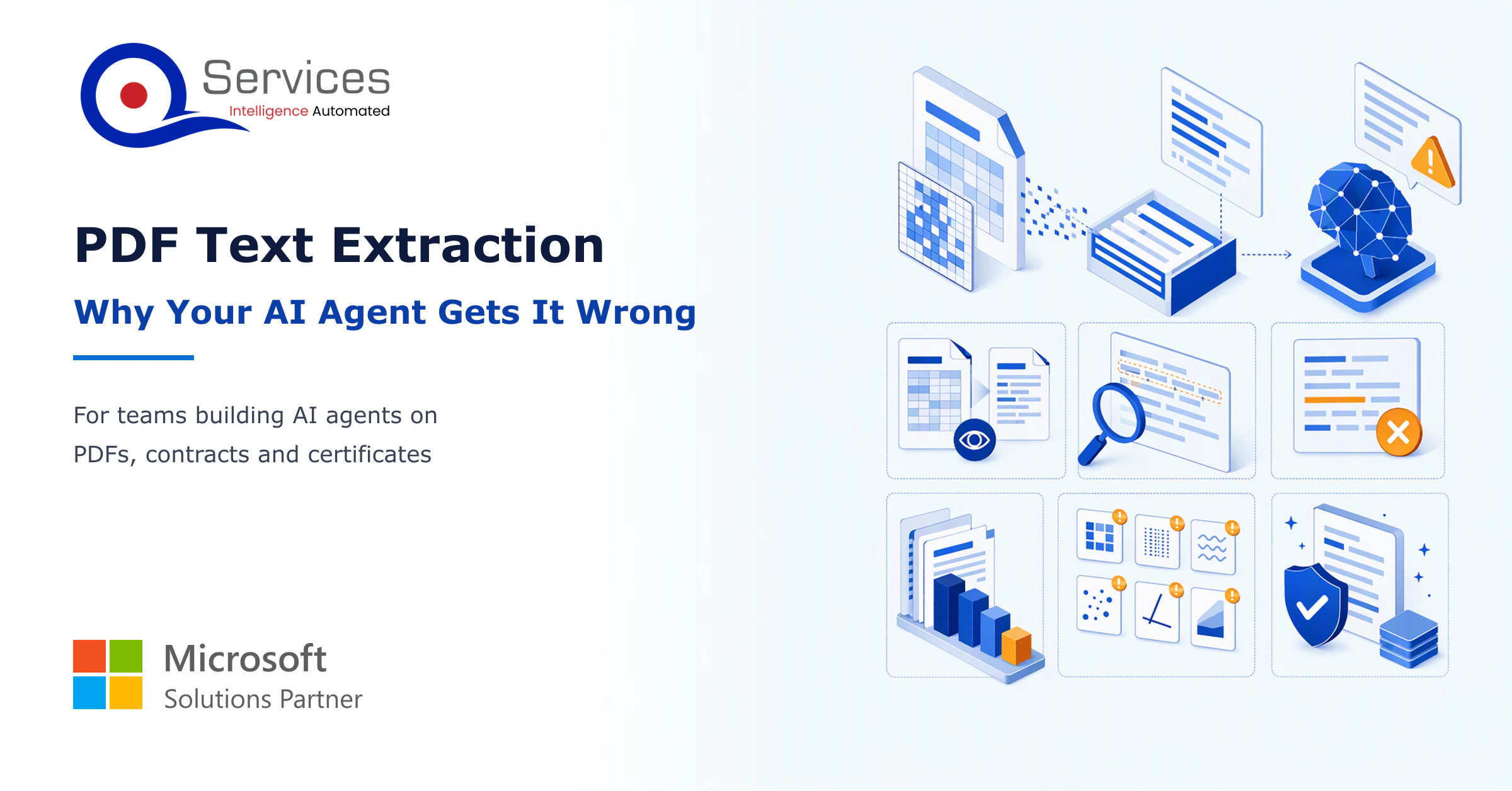
When PDF text extraction drops the spaces between words, AI agents can’t find facts that are right there. How we found it in Azure AI Foundry and fixed it.
Azure OpenAI security for production apps: identity, private networking, content filters, prompt injection defenses and monitoring to set before go-live.
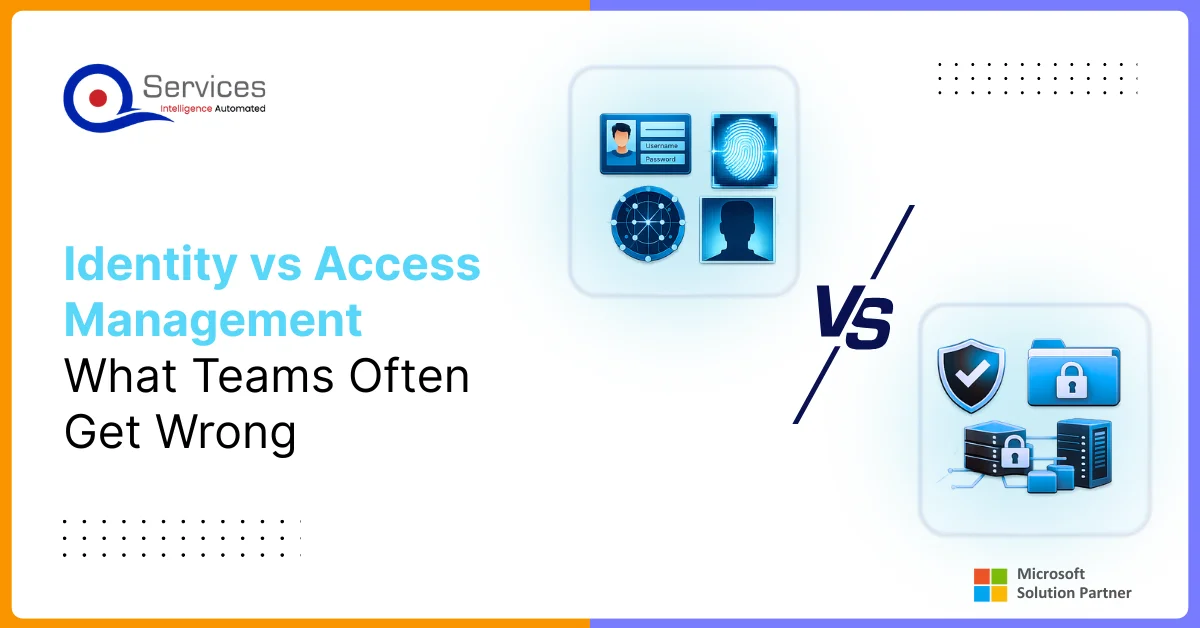
Many enterprise teams treat identity and access as if they are the same thing. They aren’t. Identity confirms who a user is. Access defines what that user is allowed to do. Assuming that an authenticated identity automatically deserves access is one of the most common—and costly organizational security mistakes.
QServices Inc. undertakes every project with a high degree of professionalism. Their communication style is unmatched and they are always available to resolve issues or just discuss the project.
Turn the Microsoft Licenses
You Already Own Into an AI Workplace
Join our live webinar on Sept 24 and see five ways to automate meetings, approvals, and