Azure cloud migration cost is the first number every CFO asks for before a project kicks off, and the answer is almost never what they expect. Ask three vendors and you'll get three wildly different quotes, often because each one is scoping a different thing. Some include only the migration execution. Others bundle in the design, testing, and post-migration support. A few just give you a number that gets the meeting to a second call.
This breakdown covers the actual cost drivers at each phase of an Azure migration, typical spend ranges for companies of different sizes, and the decisions that consistently push budgets over plan. QServices has completed 500+ Azure and Microsoft platform projects since 2014, and the patterns we see across clients are consistent enough to give you real reference points. If you're running a Microsoft-heavy technology stack and thinking about how to migrate on premise to azure, this is the breakdown you need before those vendor conversations start.
In This Article, You'll Learn
What Actually Drives Azure Cloud Migration Cost?
The Five Phases of Azure Migration and Their Costs
Azure Cloud Migration Cost Ranges by Company Size
How Azure Consulting Services Affect Total Cost
How to Migrate On-Premise to Azure Without Overspending
Eager to discuss about your project?
Share your project idea with us. Together, we’ll transform your vision into an exceptional digital product!
The honest answer is that azure cloud migration cost scales with three things: how much you have to move, how old and tangled your current environment is, and how much work needs to happen before the first server ever touches Azure. Teams that underestimate the third category are the ones that blow budgets.
Infrastructure Size and Complexity
The number of workloads, servers, databases, and custom integrations in your current environment has the most direct impact on cost. A company running 20 virtual machines with standard web applications and a SQL Server backend can migrate much faster and more cheaply than one running 200 servers with custom middleware, legacy COM+ components, and point-to-point integrations between six different systems.
Most azure infrastructure assessment engagements start by cataloging everything in the current environment. Tools like Azure Migrate and Azure Site Recovery can automate much of this discovery, but the analysis, specifically the dependency mapping, migration wave sequencing, and identifying what needs re-architecting, requires experienced engineers to interpret the data.
Migration Approach: Lift and Shift vs. App Modernization
Lift and shift to azure is the fastest approach. You move workloads as-is, with minimal code changes. It gets you out of the data center quickly, but you're often running over-provisioned VMs at higher cost than needed, and the application may not take full advantage of Azure-native services.
In our client engagements, Azure app modernization costs more upfront, typically 2x to 3x a lift-and-shift of the same workload, but it pays back through lower running costs, better scalability, and often a lower ongoing support burden. The decision between these approaches changes the budget significantly, and it's worth pressure-testing that decision early with your azure migration partner.
Regulatory and Compliance Requirements
For healthcare companies, financial services firms, or any organization handling regulated data, compliance work is a major cost multiplier. An azure security assessment to confirm HIPAA or SOC 2 readiness, proper network segmentation, Azure Policy configuration, and logging to meet audit requirements can add 20 to 40% to a migration budget. See our HIPAA-Compliant Cloud Architecture on Azure: The Full Checklist for a detailed look at what that actually involves.
Key Insight An azure security assessment to confirm HIPAA or SOC 2 readiness, proper network segmentation, Azure Policy configuration, and logging to meet audit requirements can add 20 to 40% to a migration budget.
The Five Phases of Azure Migration and Their Costs
The five phases of Azure migration are: Assess, Plan, Migrate, Optimize, and Govern. Each has a different cost profile, and skipping or under-investing in the early phases reliably inflates costs in the later ones.
Phase 1: Azure Infrastructure Assessment
In our engagements, an azure infrastructure assessment typically runs $8,000 to $25,000 depending on environment complexity. This phase uses Azure Migrate to discover workloads, maps application dependencies, identifies compliance gaps, and produces a migration roadmap with recommended wave sequencing.
Some teams try to skip this or run it informally. That's almost always a mistake. The dependency mapping alone prevents the most expensive kind of migration failure: taking a server offline mid-migration and discovering that three other applications relied on it.
Phase 2: Azure Landing Zone Implementation
Azure landing zone implementation is the foundational setup work, covering subscription design, network topology (hub-and-spoke or Virtual WAN), identity integration with Microsoft Entra ID, security baseline, and governance policy. In our engagements, this runs $15,000 to $45,000 for a mid-size company. Enterprises with complex multi-subscription architectures will see this go higher.
This phase is where an experienced azure architecture review saves real money. Decisions made here about network design and subscription structure are very hard to undo after migration. A poorly designed landing zone creates cost and technical debt that compounds over the entire life of the Azure environment.
Phase 3: Migration Execution
This is what most people think of as "the migration": actually moving workloads. Cost depends on the number of migration waves, the complexity of each workload, and how much manual testing each cutover requires. In our experience, migration execution for a mid-market company with 50 to 150 workloads typically runs $40,000 to $150,000 with a qualified azure cloud migration services partner.
Azure devops consulting services add to this cost if the team is also modernizing deployment pipelines during the migration. In our experience, that work generally runs $15,000 to $40,000, but it pays back quickly if the team was previously doing manual deployments.
Phase 4: Azure Architecture Review and Optimization
After the initial migration, a formal azure architecture review against the Microsoft Azure Well-Architected Framework typically identifies 20 to 35% cost reduction opportunities. This engagement usually runs $5,000 to $15,000 and should happen 30 to 90 days post-migration, once actual usage patterns are visible in Cost Analysis.
Key Insight After the initial migration, a formal azure architecture review against the Microsoft Azure Well-Architected Framework typically identifies 20 to 35% cost reduction opportunities.
Azure cost optimization consulting at this stage focuses on right-sizing VMs, identifying idle resources, enabling Azure Hybrid Benefit for Windows Server and SQL Server workloads, and purchasing Reserved Instances for stable workloads.
Phase 5: Ongoing Azure Managed Services
Post-migration managed services are an ongoing monthly cost, not a one-time project expense. They cover the operational work that keeps the environment healthy: monitoring, patching, backup verification, and cost governance. We cover what this looks like in detail in the managed services section below.
Azure Cloud Migration Cost Ranges by Company Size
These ranges are based on real engagements, not vendor-optimized estimates. DIY migrations can look cheaper in consulting fees but tend to accumulate technical debt and operational issues that cost more to fix later.
Company Size
Typical Workloads
Total Migration Cost Range
Small business
5 to 20 servers
$15,000 to $50,000
Mid-market
20 to 150 servers
$75,000 to $300,000
Enterprise
150+ servers
$300,000 to $2M+
A hybrid cloud azure setup, where some workloads remain on-prem during a phased transition, generally adds 10 to 20% to these ranges for hybrid connectivity and management overhead during the transition period.
How Azure Consulting Services Affect Total Cost
Working with azure consulting services firms is not just a line item. It changes how much risk you carry through the migration and what state the environment is in when you're done.
What a Microsoft Azure Consulting Company Actually Does
A microsoft azure consulting company that earns that designation does several things beyond moving servers. They should be mapping dependencies before migration, architecting the landing zone, running an azure security assessment, validating each migration wave before moving to the next, and setting up monitoring and alerting so the team has full visibility after handoff.
QServices, as a Microsoft Certified Solutions Partner specializing in Azure, includes an azure security assessment as a standard part of every migration engagement. We've seen too many migrations where security was treated as an afterthought, and the client spent more fixing vulnerabilities post-migration than they spent on the migration itself.
Azure Migration Partner vs. DIY: The Hidden Cost Gap
Internal teams that run migrations without an experienced azure migration partner tend to underestimate the complexity of identity integration, network design, and application-level testing. The typical failure modes are: VM sizing that's 40 to 60% over what's needed (because nobody had time to right-size during the migration crunch), missing dependencies discovered after cutover, and security gaps that become incidents six months later.
How to Migrate On-Premise to Azure Without Overspending
Migrate on premise to azure engagements go over budget for predictable, avoidable reasons. The biggest one is underestimating the assessment and planning phases. The second is treating CI/CD pipeline work as a separate future project when it belongs inside the migration scope.
Azure DevOps Consulting Services and CI/CD Pipeline Costs
Teams that invest in azure devops consulting services during the migration, rather than treating it as a separate future project, typically see faster post-migration deployment velocity and fewer rollbacks. Building CI/CD pipelines as you migrate means each workload arrives in Azure with automated deployment from day one.
Our Azure DevOps CI/CD pipelines guide covers the specifics of what those pipelines should include for common workload types. In our engagements, DevOps pipeline setup typically runs $1,500 to $5,000 per application depending on complexity, testing requirements, and whether you're implementing environment-specific deployment gates.
Hybrid Cloud Azure Setup Considerations
A hybrid cloud azure setup, where production workloads move to Azure but some data or services remain on-prem during a transition period, adds complexity that's easy to underestimate. ExpressRoute connectivity costs $500 to $5,000 per month depending on the circuit tier (as of 2026). VPN Gateway is cheaper but adds latency that affects certain application types.
The governance overhead of managing two environments simultaneously is also real. Teams that treat the hybrid period as temporary tend to let it drag on, and the cost of running parallel environments compounds quickly.
Most organizations land in Azure and then overspend for 6 to 12 months before anyone looks seriously at the bill. This is common, but it's avoidable with a structured post-migration optimization process.
Right-Sizing Resources After Migration
The lift-and-shift approach almost always produces over-provisioned VMs. The original on-prem servers were sized for peak load with headroom for growth. In Azure, you're paying for that unused capacity every day. Azure cost optimization consulting focused on right-sizing typically identifies 20 to 40% waste within the first 90 days post-migration.
Key Insight Azure cost optimization consulting focused on right-sizing typically identifies 20 to 40% waste within the first 90 days post-migration.
Two levers consistently reduce azure cloud migration cost over the first year post-migration: Reserved Instances and Azure Hybrid Benefit.
Reserved Instances for stable workloads save 30 to 72% compared to pay-as-you-go pricing, according to Microsoft's Reserved VM Instances documentation. Azure Hybrid Benefit lets you apply existing Windows Server and SQL Server licenses to Azure VMs, saving an additional 40% on those workloads. Organizations that don't have a licensing specialist involved in the migration routinely miss both of these.
What Does an Azure Managed Services Provider Actually Cost?
Ongoing managed services are the part of total azure cloud migration cost that surprises teams most, because it doesn't appear in the migration project quote.
Monthly Retainer Models
An azure managed services provider typically charges on one of three models: per-resource (per VM or service), percentage of Azure spend (usually 10 to 20%), or a flat monthly retainer. In our experience, for mid-market companies spending $5,000 to $30,000 per month on Azure consumption, managed services typically add $2,000 to $8,000 per month.
What drives that range is the scope of coverage: monitoring and alerting only, versus active management including patching, backup verification, incident response, and optimization reviews.
What's Included in Azure Managed Services
A good azure managed services provider handles 24/7 monitoring, alert triage, patch management, backup verification, cost reporting, and quarterly optimization reviews. Some also include security monitoring and SIEM integration.
The honest tradeoff is that managed services cost more than pure self-management. But they prevent the 2 AM outage that costs far more than a month of retainer fees. For regulated industries, managed services also make compliance reporting significantly easier.
Is Azure Cheaper Than AWS for Enterprise Workloads?
This question comes up in almost every enterprise evaluation, and the real answer depends heavily on your existing licensing position.
Where Azure Wins on Cost
Azure tends to win on total cost for Microsoft-heavy organizations: those running Windows Server, SQL Server, .NET applications, Active Directory, or Microsoft 365. The Azure Hybrid Benefit, combined with existing Enterprise Agreement pricing, can make Azure 30 to 50% cheaper than equivalent AWS infrastructure for these workloads. Gartner's cloud strategy research consistently shows that organizations migrating Microsoft workloads to Azure see better total cost of ownership than those moving the same workloads to AWS.
Hidden Costs That Surprise Finance Teams
Egress costs (charges for data leaving Azure) catch a lot of teams off guard. So does the cost of Azure Firewall at scale, which is priced per deployment hour plus per-GB processed, not intuitive for teams used to on-prem firewall appliances. Licensing for third-party software running on Azure, such as antivirus tools, monitoring platforms, and backup solutions, often gets missed in migration budgeting entirely.
How QServices Approaches Azure Cloud Migration
QServices is a Microsoft Certified Solutions Partner specializing in Azure, with 500+ Azure and Microsoft platform projects completed since 2014 across healthcare, financial services, logistics, and SaaS.
Our Five-Phase Process
We run every migration through a structured process: Assess (azure infrastructure assessment and dependency mapping), Plan (azure architecture review and landing zone design), Migrate (phased wave-based migration with testing gates), Optimize (azure cost optimization consulting starting at day 30), and Govern (ongoing managed services and policy enforcement).
The assessment phase is non-negotiable for us. We've inherited too many migrations from other firms where the assessment was skipped, and the client is still paying for those shortcuts three years later.
Human-in-the-Loop Governance at Every Stage
Every deployment in our delivery model requires human approval before it executes in production. Human-in-the-Loop governance isn't something we describe in theory; it's embedded in how we configure Azure DevOps pipelines, approval workflows, and change management for every migration engagement. This applies to infrastructure-as-code deployments too, where automated tooling does the heavy lifting but humans review and approve every change before it runs. Our approval workflows guide explains how this works in practice across different project types.
Key Takeaways
The honest answer is that azure cloud migration cost scales with three things: how much you have to move, how old and tangled your current environment is, and how much work needs to happen before the first server ever touches Azure.
The five phases of Azure migration are: Assess, Plan, Migrate, Optimize, and Govern.
These ranges are based on real engagements, not vendor-optimized estimates.
Working with azure consulting services firms is not just a line item.
Migrate on premise to azure engagements go over budget for predictable, avoidable reasons.
Conclusion
In our engagements, Azure cloud migration cost ranges from $15,000 for a small business moving a handful of servers to $2M or more for a large enterprise with complex regulatory requirements and hundreds of workloads. The number depends on your environment's complexity, the migration approach you choose, how seriously you invest in the assessment and landing zone phases, and what managed services coverage you need after go-live.
The most expensive migrations we've seen weren't the largest. They were the ones where teams skipped the assessment, chose a low-bid azure migration partner with thin Azure depth, or treated security and compliance as a post-migration cleanup task. Getting azure consulting services from a qualified microsoft azure consulting company at the start of an engagement consistently costs less than fixing those problems in production.
If you want a realistic estimate for your specific environment, reach out to QServices for an initial conversation. We'll give you an honest assessment of what we see in environments like yours and what it will realistically take to get to Azure successfully.
Co-Founder and CTO, QServices IT Solutions Pvt Ltd
Rohit Dabra is the Co-Founder and Chief Technology Officer at QServices, a software development company focused on building practical digital solutions for businesses. At QServices, Rohit works closely with startups and growing businesses to design and develop web platforms, mobile applications, and scalable cloud systems. He is particularly interested in automation and artificial intelligence, building systems that automate routine tasks for teams and organizations.
Azure cloud migration cost varies significantly based on environment size and complexity. Small business migrations covering 5 to 20 servers typically run $15,000 to $50,000. Mid-market companies with 20 to 150 workloads generally spend $75,000 to $300,000. Enterprise migrations with 150+ servers start at $300,000 and can exceed $2 million when complex regulatory requirements, custom integrations, and app modernization are included. These figures cover the full engagement: assessment, landing zone setup, migration execution, and post-migration optimization.
The best approach depends on your timeline and application portfolio. Lift and shift to Azure is fastest and lowest upfront cost, moving workloads as-is with minimal code changes. Azure app modernization costs 2x to 3x more upfront but reduces ongoing running costs and support burden. Most mid-market migrations use a blended approach: lift-and-shift for simpler workloads, with targeted modernization for applications that directly benefit from Azure-native services. Working with a qualified azure migration partner to assess each workload individually produces better outcomes than applying a single strategy across the board.
A small business migration with 5 to 20 servers typically completes in 4 to 8 weeks. Mid-market migrations with 50 to 150 workloads generally take 3 to 6 months when run in properly sequenced waves. Enterprise migrations with hundreds of workloads can take 12 to 24 months. These timelines assume a completed azure infrastructure assessment before migration execution begins. Skipping the assessment phase or under-resourcing the project consistently extends timelines by 30 to 50%.
An Azure landing zone is the foundational environment that all migrated workloads run in. It includes subscription design, network topology (typically hub-and-spoke or Virtual WAN), identity integration with Microsoft Entra ID, security baseline policies, governance controls, and monitoring configuration. Azure landing zone implementation is the setup work done before any workloads migrate. A properly designed landing zone takes 2 to 6 weeks and costs $15,000 to $45,000 for a mid-market company. Skipping this step and migrating directly into a flat, ungoverned Azure environment is one of the most common causes of post-migration security incidents and cost overruns.
For Microsoft-heavy organizations running Windows Server, SQL Server, .NET applications, or Microsoft 365, Azure is typically 30 to 50% cheaper than equivalent AWS infrastructure. This advantage comes primarily from Azure Hybrid Benefit, which lets you apply existing Microsoft licenses to Azure VMs, and Enterprise Agreement pricing. For Linux-based or cloud-native workloads, the cost difference is smaller and depends more on specific service pricing. Organizations with no existing Microsoft licensing see less of a price advantage with Azure.
An azure managed services provider handles ongoing operations of your Azure environment after migration. Core services include 24/7 monitoring and alerting, patch management, backup verification, incident response, security monitoring, cost reporting, and quarterly optimization reviews. Some providers also include Azure DevOps pipeline management and compliance reporting for regulated industries. Monthly costs typically range from $2,000 to $8,000 for mid-market companies spending $5,000 to $30,000 per month on Azure consumption, depending on the scope of coverage.
Evaluate azure consulting services providers on three criteria: Microsoft certification level (Solutions Partner for Azure is the highest tier), actual migration references from companies of similar size and industry, and the specifics of what their assessment process covers. Ask for their dependency mapping methodology, how they handle regulatory compliance requirements, and whether post-migration optimization is included in the engagement or sold separately. Partners who skip the assessment or don’t mention landing zone design in early conversations are showing you their process gaps before the work even starts.
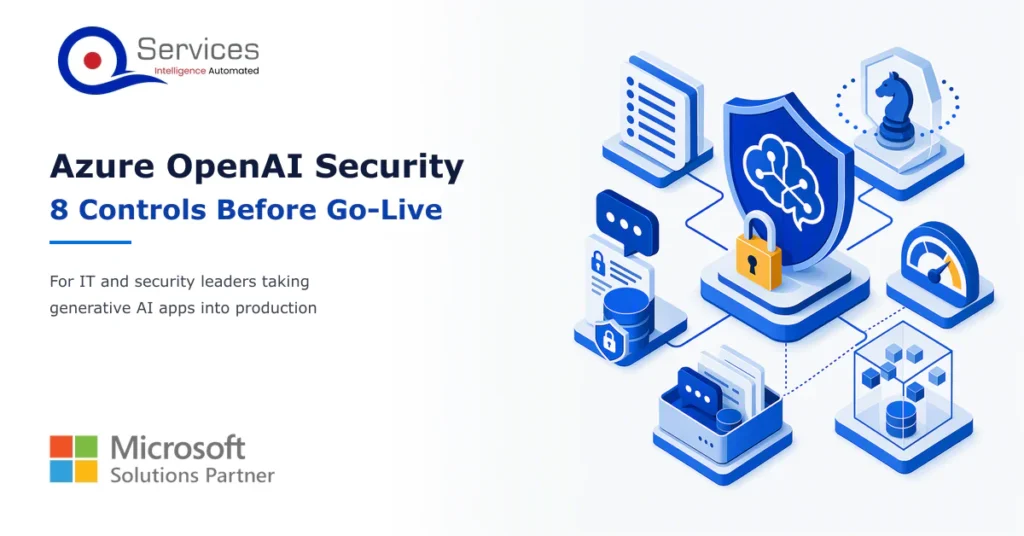
Azure OpenAI security for production apps: identity, private networking, content filters, prompt injection defenses and monitoring to set before go-live.
Business intelligence consulting services should give a mid-market company a governed way to make decisions. Attractive dashboards are only the visible part. The useful outcome is a system in which source data, metric definitions, access, releases, ownership, and support still work after the consultants leave.
In a Microsoft Solutions Partner vs Microsoft Partner comparison, the difference is validation. A company can participate in the Microsoft AI Cloud Partner Program without holding a customer-facing Solutions Partner designation. A designated Solutions Partner has met Microsoft’s current threshold in a specific solution pathway: at least 70 out of 100 partner capability points, with more than zero points in every required metric, based on performance, skilling, and customer success data recorded in Partner Center.
Azure OpenAI security for production apps: identity, private networking, content filters, prompt injection defenses and monitoring to set before go-live.
Business intelligence consulting services should give a mid-market company a governed way to make decisions. Attractive dashboards are only the visible part. The useful outcome is a system in which source data, metric definitions, access, releases, ownership, and support still work after the consultants leave.
In a Microsoft Solutions Partner vs Microsoft Partner comparison, the difference is validation. A company can participate in the Microsoft AI Cloud Partner Program without holding a customer-facing Solutions Partner designation. A designated Solutions Partner has met Microsoft’s current threshold in a specific solution pathway: at least 70 out of 100 partner capability points, with more than zero points in every required metric, based on performance, skilling, and customer success data recorded in Partner Center.
QServices Inc. undertakes every project with a high degree of professionalism. Their communication style is unmatched and they are always available to resolve issues or just discuss the project.
Turn the Microsoft Licenses
You Already Own Into an AI Workplace
Join our live webinar on Sept 24 and see five ways to automate meetings, approvals, and