Choosing between no-code vs low-code vs custom software for SMBs is one of the most consequential technology decisions your business will make in 2026. Get it right and you ship faster, spend less, and keep technical debt manageable. Get it wrong and you either overpay for developers when a $50/month tool would have done the job, or you lock your core operations into a platform that breaks when you hit 500 users. Five practical factors separate the right choice from the expensive one.
Understanding No-Code, Low-Code, and Custom Software
No-code platforms let non-technical users build applications through drag-and-drop interfaces with zero programming. Tools like Microsoft Power Apps canvas apps, Bubble, and Airtable fall here. You configure logic visually and the platform handles everything underneath.
Low-code platforms speed up developer work by replacing repetitive coding with visual builders, while still allowing custom logic where needed. Microsoft Power Platform, OutSystems, and Mendix are the most common examples in the SMB space. A developer or a technically proficient business analyst can ship an app in days instead of weeks.
Custom software means writing code from scratch using frameworks like .NET, Node.js, or Flutter. You have complete control over architecture, data models, and user experience. The tradeoff is time and money.
These three options are not a strict hierarchy. The right pick depends on the problem you are solving, not on which option sounds most professional.
Factor 1: Budget and What You Will Actually Pay
Budget is usually the first filter, and the honest cost picture for no-code vs low-code vs custom software for SMBs in 2026 looks like this.
No-code tools typically run $25-$150 per user per month on SMB-tier plans. For a 10-person team using Power Apps bundled with a Microsoft 365 Business Premium license, you are looking at roughly $220/month. That sounds cheap, but costs accelerate once you add premium connectors, more data storage, or additional Dataverse capacity.
Low-code development sits in a gray zone. If you are already on Power Platform through Microsoft 365, your base platform cost is near zero. The real spend is on developer or consultant time to configure it, typically $75-$150/hour for a Power Platform specialist. A medium-complexity Power Apps project might run $8,000-$25,000 to build, then $500-$2,000/month to maintain.
Custom software is where costs get serious. A custom web or mobile app built by a qualified .NET or Flutter team typically starts at $40,000-$80,000 for a first version, with $3,000-$8,000/month to maintain and evolve. Some SMBs cut this by 30-40% by working with vetted remote development teams. For a deeper breakdown of what separates no-code from bespoke builds financially, see Low-Code vs Bespoke Software: Startup Cost Breakdown.
The total cost of ownership is what actually matters. A $99/month no-code tool that your team replaces in 18 months because it cannot handle your data volume ends up costing more than a $45,000 custom build with a five-year lifespan.
Factor 2: How Fast Do You Need to Ship?
Time-to-market matters differently depending on what you are building.
No-code is the fastest option. A Power Apps canvas app connected to a SharePoint list can be live in a day. An Airtable-powered internal tool might take an afternoon. If you need something working by Friday for a client demo or a process fix, no-code wins every time.
Low-code adds a few weeks. A Power Platform solution with custom flows, a model-driven app, and Dataverse integration typically takes 3-8 weeks from spec to deployment. That is still dramatically faster than custom development. Our post on Low-Code App Development: What Startups Must Know in 2026 walks through realistic timelines for common SMB use cases.
Custom development takes 3-6 months minimum for a functional v1, often longer. You can move faster with experienced teams or pre-built component libraries, but you cannot responsibly rush architecture decisions. If your business cannot wait that long, custom development is not the right starting point.
One honest note: speed advantages erode over time. A no-code app built in a day might take three months to refactor when your requirements grow, while a well-architected custom app takes days to extend. Front-loaded speed often becomes back-loaded rework.
Eager to discuss about your project?
Share your project idea with us. Together, we’ll transform your vision into an exceptional digital product!
Factor 3: Will It Scale? No-Code vs Low-Code vs Custom Software for Growing SMBs
This is where many SMBs get burned. They pick no-code for good reasons (speed, cost) and then hit platform limits at exactly the moment their business is growing.
No-code platforms have hard ceiling limits. Power Apps Dataverse defaults to a 4 GB storage cap per environment on entry-level plans. Bubble's free tier throttles server capacity under load. When you have 1,000 daily active users running complex queries, low-tier no-code tools start failing in ways that are difficult to fix without rebuilding from scratch.
Low-code scales better, especially within the Microsoft ecosystem. Power Platform with Azure Dataverse can handle enterprise-grade data volumes when configured correctly. You can extend low-code apps with Azure Functions for heavy computation, which sidesteps most platform limits. According to Gartner's low-code development research, low-code platforms are increasingly adopted for mission-critical applications, not just internal tooling.
Custom software scales on your terms. You control the database schema, the API design, the caching strategy, and the deployment architecture. If you are building a product that other businesses pay for, a SaaS application, a client portal, or a fintech tool, custom software is almost always the right long-term choice. The scalability ceiling is determined by your cloud architecture, not someone else's platform.
The question to ask before deciding: "What happens when this app needs to serve 10x more users or process 10x more data?" If the answer is "we rebuild it," that is a risk worth pricing into your current decision.
Factor 4: Integration Complexity and Data Requirements
Most SMB software projects do not live in isolation. They need to connect to your CRM, accounting system, HR platform, or cloud data store, and the integration requirements often determine which approach makes practical sense.
No-code tools have pre-built connectors that work well for standard integrations: Microsoft 365, Salesforce, QuickBooks, Stripe. Power Apps alone has over 1,000 connectors. If your stack is mainstream and your data flows are straightforward, no-code handles this well.
The problems start when you need custom authentication, complex data transformations, or high-volume API calls. Many no-code platforms throttle API requests at 1,000-5,000 calls per day on standard plans. For a fintech startup processing thousands of transactions daily, that is a hard blocker.
Low-code handles integration better because you can write code when the visual builder falls short. Power Automate can call any REST API using custom HTTP actions. You can build custom connectors for systems that lack native support. If you are working with Azure services, the integration story is even cleaner since Power Platform runs on Azure's identity and data infrastructure. Our guide to Power Automate vs Logic Apps vs D365: when to use each covers the right tool for each integration scenario in detail.
Custom software has no integration limits beyond engineering time. You write the connector, define the data contract, and own the pipeline. For businesses with complex legacy systems, proprietary data formats, or regulated data flows such as KYC in banking or claims processing in insurance, custom code is often the only practical option.
Eager to discuss about your project?
Share your project idea with us. Together, we’ll transform your vision into an exceptional digital product!
The best technology choice is the one your team can actually operate and maintain over time.
No-code requires almost no technical skills to run day-to-day. A business analyst, an operations manager, or even a founder with patience can own a no-code app after an initial build. The downside is that same person often creates technical debt over time: duplicate logic, inconsistent naming conventions, ungoverned automations. Without some technical oversight, no-code environments get messy fast.
Low-code works best when you have at least one person comfortable with data modeling, basic scripting, and API concepts. You do not need a full developer, but you need someone who can troubleshoot a failed Power Automate flow at 9 PM when a critical business process breaks. Many SMBs hire a part-time Power Platform consultant for exactly this role.
Custom software requires a development team or a trusted development partner. This is the highest bar of the three. If you are evaluating whether to bring in remote developers for a custom project, the vetting and onboarding process matters as much as the technology choice itself. Our guide on Hire a Remote .NET Developer: Essential SMB Guide covers what to look for when building external custom development capacity.
A practical test before committing to any approach: who owns this application in 12 months? If the answer is "probably whoever built it and has since left," that is a maintenance problem regardless of which path you chose.
No-Code vs Low-Code vs Custom Software for SMBs: Decision Matrix
Here is a practical matrix to guide your SMB software development strategy. Score your project against each factor before committing to a direction.
Factor
No-Code
Low-Code
Custom Software
Typical build cost
$0-$5,000
$8,000-$25,000
$40,000-$120,000
Time to v1
Days to 2 weeks
3-8 weeks
3-6 months
Scalability ceiling
Low-Medium
Medium-High
High
Integration depth
Pre-built connectors
Custom connectors + code
Full control
Team skills needed
Low
Medium
High
Vendor lock-in risk
High
Medium
Low
Best for
Internal tools, prototypes
Departmental apps, workflows
Customer products, SaaS
The most common mistake in this decision is treating these options as mutually exclusive. Many SMBs benefit from using all three at once, each in a different context.
Where Microsoft Power Platform Fits the No-Code vs Low-Code Decision
For SMBs already in the Microsoft ecosystem, Power Platform sits at a practical sweet spot between no-code and low-code. Power Apps for quick internal tools, Power Automate for workflow automation, and Power BI for reporting can handle a surprising amount of business logic without writing a single line of code.
The Microsoft Power Platform documentation covers the full capability set, but the practical reality for SMBs is straightforward: if you have Microsoft 365 Business Premium or an existing Dynamics 365 license, you already have access to a Power Platform environment. The marginal cost to build your first internal app is close to zero.
That said, Power Platform is not a replacement for custom software. It works best for automating internal workflows, building departmental apps, and connecting Microsoft services together. Once you need a multi-tenant web application, a public API, or a mobile app with complex offline capabilities, you are outside what Power Platform handles well. For concrete examples of what Power Platform can deliver for SMBs right now, 5 Power Platform Low-Code Solutions for SMBs walks through five real-world applications.
When Mixing No-Code, Low-Code, and Custom Makes Sense
The either-or framing of the no-code vs low-code vs custom software for SMBs debate is mostly artificial. Mature SMB software stacks typically mix all three approaches.
A common pattern: a startup builds its customer-facing product as custom software on Azure (.NET API, React or Flutter front end), automates internal operations with Power Automate, and uses Power BI for reporting dashboards. The custom layer handles the business logic that differentiates the product. The no-code and low-code layers handle operational work that does not need to be proprietary.
This hybrid approach keeps total costs lower than going fully custom everywhere, while avoiding the platform-limit problems that come from running critical customer-facing processes on no-code tools.
The global low-code market is projected to exceed $65 billion by 2027, according to Statista's low-code and no-code platform market data. Most of that growth is coming from businesses using low-code alongside traditional development, not as a wholesale replacement for it.
Conclusion
The no-code vs low-code vs custom software decision for SMBs is not about finding the "best" option in the abstract. It is about matching the tool to the specific problem. No-code works well for internal tools and prototypes where speed matters most. Low-code, especially on Microsoft Power Platform, is the right choice for workflow automation and departmental apps with a defined scope. Custom software is the right answer when you are building a product that customers pay for, or when your requirements exceed what any platform can provide out of the box.
Use the five factors in this post (budget, speed, scalability, integration, and team capacity) to score each option against your project. Most SMBs end up using all three in parallel, each in its lane, and that is not a compromise. It is a practical strategy that keeps costs manageable and keeps your core product competitive.
If you are ready to work through which approach fits your next project, our team offers a no-obligation software strategy review tailored to your business size and goals.
Co-Founder and CTO, QServices IT Solutions Pvt Ltd
Rohit Dabra is the Co-Founder and Chief Technology Officer at QServices, a software development company focused on building practical digital solutions for businesses. At QServices, Rohit works closely with startups and growing businesses to design and develop web platforms, mobile applications, and scalable cloud systems. He is particularly interested in automation and artificial intelligence, spending time experimenting with tools and building systems that automate routine tasks. Through his writing and projects, he explains practical ways to use modern technologies such as AI agents, automation platforms, and cloud-based systems in real business scenarios.
No-code platforms like Power Apps and Bubble let non-technical users build apps through drag-and-drop interfaces with zero programming. Low-code platforms like Microsoft Power Platform let developers and technically proficient analysts build apps faster using visual tools, while still writing code for complex logic. Custom software is built from scratch using full programming frameworks like .NET, Node.js, or Flutter, giving complete control over architecture and functionality. The key difference is the tradeoff between speed and control: no-code is fastest but most constrained, custom is slowest but most flexible, and low-code sits in between.
A startup should use no-code when it needs an internal tool, a prototype, or a process automation quickly and inexpensively, and when the required functionality is covered by the platform’s pre-built connectors. Good candidates include approval workflows, data entry forms, simple reporting dashboards, and team notification systems. If the app is customer-facing, handles sensitive data at scale, or requires custom integrations not available as connectors, hiring a developer or using a low-code platform is the better choice.
The main limitations are storage caps (Power Apps Dataverse defaults to 4 GB per environment on entry-level plans), API call throttling (often 1,000-5,000 calls per day on standard plans), limited customization of data models and business logic, vendor lock-in to the platform’s data format and connector ecosystem, and difficulty handling complex multi-step workflows with conditional branching. As a business grows past 200-500 users or starts processing high transaction volumes, these limits often require rebuilding the application in a more flexible environment.
If your use case is internal workflow automation, departmental tooling, or connecting Microsoft 365 services, Power Platform is almost certainly the right starting point, especially if you already have a Microsoft 365 license that includes Power Apps. If you are building a customer-facing product, a SaaS application, or a tool that needs to handle complex business logic, high user volumes, or deep third-party integrations, custom development is the better long-term investment. Many startups use both: Power Platform for internal operations and custom code for their core product.
No-code tools typically cost $25-$150 per user per month, with most SMB projects staying under $5,000 in initial setup costs. Custom software development for a functional first version typically starts at $40,000-$80,000 for a web or mobile application, with $3,000-$8,000 per month in ongoing maintenance. The 3-year total cost of ownership for custom software is higher upfront but can be lower over time if no-code platform upgrade costs or forced rebuild expenses are factored into the comparison.
No-code apps can scale to a point, but most platforms have hard limits on storage, API calls, and concurrent users that become blockers for businesses growing past 200-500 active users. Low-code platforms like Microsoft Power Platform scale better because you can extend them with Azure Functions and adjust Dataverse capacity as needed. For businesses with a clear growth trajectory toward high user volumes or complex data processing requirements, planning for an eventual migration to low-code or custom development from the start is more cost-effective than rebuilding under pressure later.
A no-code app can be live in hours to a few days for simple use cases, or 1-2 weeks for more complex internal tools. A low-code solution built on Power Platform typically takes 3-8 weeks from specification to deployment. Custom software development takes a minimum of 3-6 months for a working first version, sometimes longer for products with complex requirements. The speed gap is significant upfront, but a well-architected custom app is much faster to extend and modify over time than a no-code app approaching its platform limits.
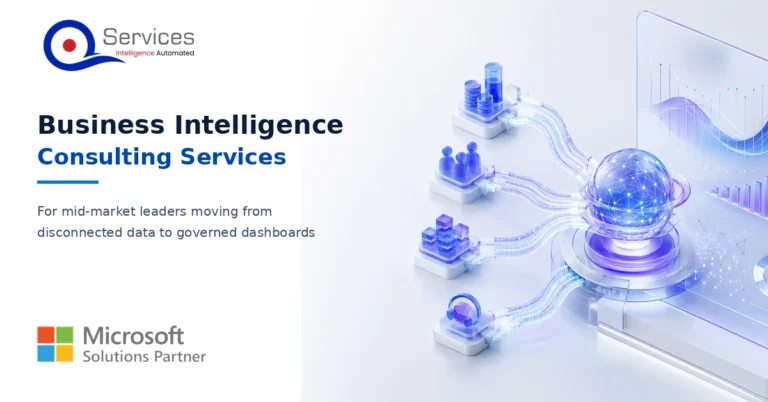
Business intelligence consulting services should give a mid-market company a governed way to make decisions. Attractive dashboards are only the visible part. The useful outcome is a system in which source data, metric definitions, access, releases, ownership, and support still work after the consultants leave.
In a Microsoft Solutions Partner vs Microsoft Partner comparison, the difference is validation. A company can participate in the Microsoft AI Cloud Partner Program without holding a customer-facing Solutions Partner designation. A designated Solutions Partner has met Microsoft’s current threshold in a specific solution pathway: at least 70 out of 100 partner capability points, with more than zero points in every required metric, based on performance, skilling, and customer success data recorded in Partner Center.
Business intelligence consulting services should give a mid-market company a governed way to make decisions. Attractive dashboards are only the visible part. The useful outcome is a system in which source data, metric definitions, access, releases, ownership, and support still work after the consultants leave.
In a Microsoft Solutions Partner vs Microsoft Partner comparison, the difference is validation. A company can participate in the Microsoft AI Cloud Partner Program without holding a customer-facing Solutions Partner designation. A designated Solutions Partner has met Microsoft’s current threshold in a specific solution pathway: at least 70 out of 100 partner capability points, with more than zero points in every required metric, based on performance, skilling, and customer success data recorded in Partner Center.