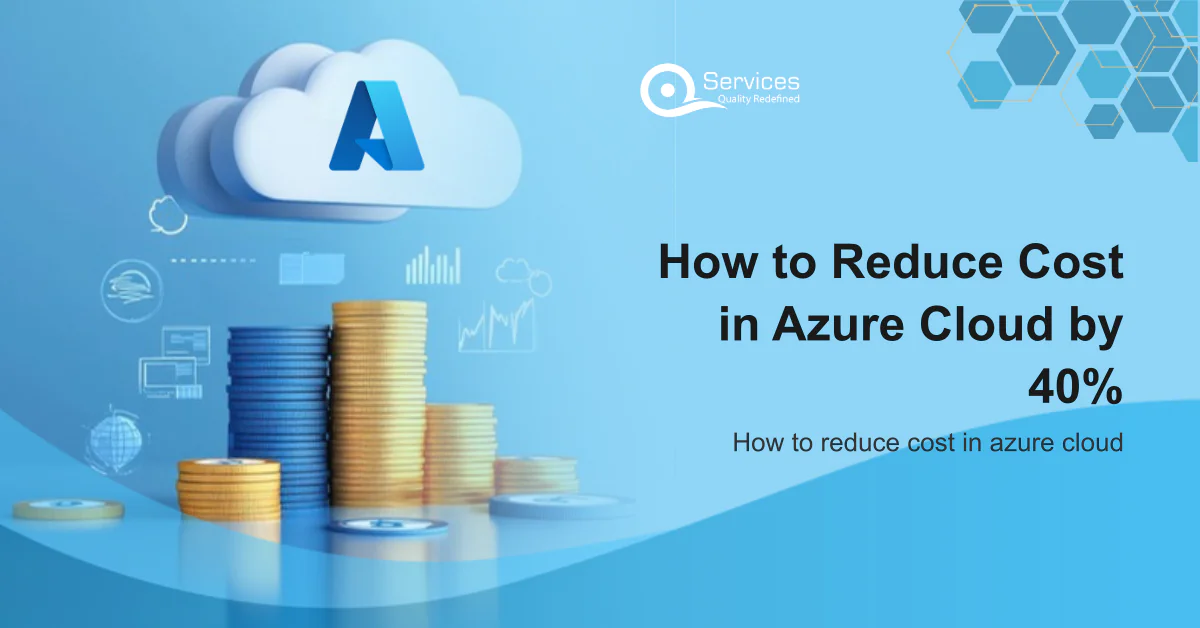
If you want to know how to reduce cost in Azure cloud without sacrificing performance, this guide gives you a concrete, numbers-backed path to doing exactly that. Studies consistently show that organizations running workloads on public cloud overspend by 30-35% on average, according to the Flexera 2024 State of the Cloud Report. For startups and SMBs operating under tight budgets, that wasted spend is money that could go toward hiring, product development, or customer acquisition. The good news: Azure has a set of native tools and purchasing strategies that, when used together, can cut your monthly bill by 40% or more. This guide walks through all of them.
Why Azure Cloud Costs Spiral Out of Control for SMBs
Most SMBs start on Azure using pay-as-you-go pricing. That's reasonable in the early days. You don't know exactly what you'll need, so you pick resources conservatively and keep everything running.
The problem is that most teams never revisit those defaults. Virtual machines run at 15% CPU utilization around the clock. Storage accounts accumulate snapshots nobody ever cleans up. Dev and test environments run on weekends when no one is working. Over 6-12 months, these small inefficiencies compound into a bill that's significantly higher than it should be.
Three patterns drive most unnecessary Azure spend:
Over-provisioned resources: VMs sized for peak load but running at low average utilization
Idle resources: Environments left running outside working hours
Unmanaged data growth: Snapshots, old backups, and orphaned disks that accumulate silently
Understanding these patterns is the first step toward fixing them.
How to Reduce Cost in Azure Cloud Using Reserved Instances
Azure Reserved Instances (RIs) can save between 40% and 72% compared to pay-as-you-go pricing on the same virtual machine SKUs. That's not a marketing claim. It's published in Microsoft's own documentation on Azure Reserved VM Instances.
The mechanism is simple: you commit to using a specific VM size in a specific Azure region for either 1 year or 3 years. In exchange, Microsoft gives you a significant discount over the equivalent on-demand rate. You pay for the reservation whether or not the resource is running, so this only makes sense for workloads with predictable, sustained usage.
When Reserved Instances Make Sense for Your Business
Reserved instances work best for:
Production web servers and API backends running 24/7
Databases with consistent query volumes
Background processing jobs with reliable schedules
Dev servers that your team uses every business day
They don't make sense for burst workloads, seasonal resources, or anything you spin up less than 70% of the time. For those cases, pay-as-you-go or spot instances are the better option.
Our detailed breakdown in Reduce Cloud Costs by 40% with Azure Reserved Instances covers how to pick the right reservation scope, manage exchanges, and calculate your actual payback period. If a VM is running more than 70% of the time, a 1-year reservation typically recovers its cost premium within 4-5 months.
Azure Auto-Scaling: Pay Only for What You Use
Auto-scaling is one of the most effective ways to reduce cost in Azure cloud for workloads with variable traffic. The idea is straightforward: Azure automatically adds capacity when demand spikes and removes it when demand drops. You stop paying for idle compute.
Azure supports auto-scaling through several mechanisms:
Virtual Machine Scale Sets (VMSS): Scale sets of identical VMs based on CPU, memory, or custom metrics
Azure App Service auto-scale: For web apps, APIs, and function apps
Azure Kubernetes Service (AKS) cluster autoscaler: Adds or removes nodes based on pod scheduling needs
Auto-Scaling Best Practices for Small Businesses
Getting auto-scaling right takes more than just enabling the feature. A few practices make the difference between smooth operation and unpredictable bills:
Set both scale-out and scale-in rules. Many teams only configure scale-out (adding capacity) but forget scale-in (removing it). Your bill keeps climbing even after the traffic spike ends.
Use custom metrics where possible. CPU utilization is a blunt instrument. For a web app, requests per second or queue depth often trigger scaling at a more accurate threshold.
Add cooldown periods. Without cooldown windows, Azure can oscillate between scaling up and down rapidly. A 5-minute cooldown after each scaling event prevents this.
Test your scale-in behavior. Run load tests against your staging environment to confirm that resources are actually removed after simulated traffic drops.
A well-configured auto-scaling setup can cut compute costs by 20-30% compared to static provisioning. Combined with reserved instances on your baseline capacity, the savings stack quickly.
Eager to discuss about your project?
Share your project idea with us. Together, we’ll transform your vision into an exceptional digital product!
Workload-Based Resource Benchmarking for Azure Cost Optimization
Most Azure cost guides tell you to right-size your VMs. That's good advice, but it's not specific enough to act on directly. Workload-based resource benchmarking gives you a precise, repeatable framework.
The approach has four steps:
Measure actual resource consumption for each workload over a 30-day period. Azure Monitor and Azure Advisor both provide this data. Look at average CPU, peak CPU, average memory, and network throughput.
Classify workloads by utilization tier: high (above 70% average CPU), medium (40-70%), and low (below 40%).
Right-size based on tier: Downsize low-utilization VMs to the next smaller SKU. For high-utilization VMs, consider whether auto-scaling is a better solution than a larger static instance.
Repeat quarterly. Usage patterns change as your product evolves and your team grows. A VM sized correctly 6 months ago may already be over- or under-provisioned.
Microsoft's own data indicates that roughly 30% of cloud workloads run on over-provisioned VMs. Right-sizing those workloads typically produces 20-30% cost savings with no performance impact.
Knowing how to reduce cost in Azure cloud is partly about strategy and partly about using the right tools. Azure provides a solid set of native cost management capabilities that most SMBs underuse.
Azure Cost Management + Billing is the primary tool. It shows real-time spend by resource, resource group, subscription, and tag. You can set budgets and configure alerts when spending crosses a threshold, which prevents the bill shock many teams experience at month-end.
Azure Advisor analyzes your environment and generates specific cost recommendations. It flags idle VMs, underused ExpressRoute circuits, and suggests reservation purchases based on your usage history. Each recommendation includes an estimated monthly savings figure, so you can prioritize by impact.
Azure Pricing Calculator lets you model costs before you provision resources. This is particularly useful when architecting new features or planning migrations. You can access it at azure.microsoft.com/en-us/pricing/calculator.
Azure Monitor provides the utilization data you need for workload benchmarking. Set up dashboards tracking CPU, memory, and disk across your key resources. Without this visibility, right-sizing decisions are guesswork.
Azure vs AWS: Which Is Actually Cheaper for Small Businesses?
The honest answer: it depends on your workload, but Azure often wins for Microsoft-centric businesses. Azure pricing for small businesses carries a significant advantage when existing Microsoft licenses are already in play.
Here's a direct comparison for common SMB workloads:
Azure's biggest cost advantage for SMBs comes from two sources. First, the Azure Hybrid Benefit lets you bring existing Windows Server and SQL Server licenses to Azure, saving up to 40% compared to running the same workloads on AWS without those licenses. Second, Azure's integration with Microsoft 365 means many SMBs are already paying for tools (Azure AD, Intune, Defender) that would cost extra on AWS.
That said, if your stack is primarily open-source Linux workloads with no Microsoft dependencies, AWS or Google Cloud may offer comparable pricing. The comparison isn't always one-sided.
The Hidden Costs of DIY Cloud Infrastructure vs Managed Azure Services
One of the most underappreciated questions for startups is whether to manage Azure infrastructure themselves or use a managed services provider. The upfront cost of DIY looks lower. The total cost often isn't.
DIY cloud infrastructure carries several hidden costs that rarely appear in the initial budget:
Engineering time: A typical SMB spends 15-25% of developer time on infrastructure management. At a loaded cost of $120 per hour for a developer, that's $50,000-$80,000 per year in opportunity cost.
Incident response: Without 24/7 monitoring, outages during off-hours go undetected. Each hour of downtime for an e-commerce site costs real revenue.
Compliance gaps: SOC 2, HIPAA, and PCI DSS compliance require documented configurations and audit trails. DIY teams often discover these gaps during their first audit, at significant remediation cost.
Suboptimal architecture: Teams without deep Azure expertise tend to over-provision and under-optimize, which is exactly the 30-40% overspend pattern described at the start of this guide.
Managed Azure services from a specialist provider typically cost 20-30% of the total infrastructure bill. But the combination of reduced overspend, faster incident response, and freed developer time usually makes the economics favorable for businesses in the $1M-$10M ARR range.
How to Calculate and Control Snapshot Costs in Azure
Azure snapshot costs are one of the most common sources of bill creep for SMBs. Snapshots are incremental after the first, but if you're taking daily snapshots of large managed disks and never deleting them, costs accumulate fast.
Select your storage tier (Premium SSD, Standard SSD, or Standard HDD)
Enter the size of the source disk
Snapshot pricing is charged per GB of used storage, at the same rate as the underlying disk tier
For example: a 1 TB Premium SSD disk with 500 GB of used data generates a snapshot costing roughly $0.06 x 500 = $30 per month. Keep 30 daily snapshots and that's $900 per month for a single disk.
Snapshot Management Best Practices
Set a retention policy. Azure Backup lets you define how long snapshots are kept before automatic deletion. Seven days of daily snapshots plus four weeks of weekly snapshots is a solid baseline for production databases.
Use Azure Backup policies instead of ad-hoc snapshots wherever possible. They enforce consistent retention and provide centralized management.
Audit orphaned snapshots quarterly. Run az snapshot list filtered by creation date to find snapshots older than 90 days. Review and delete those no longer tied to active workloads.
Consider storage tiering for infrequently accessed snapshot data. Moving older snapshots to cool or archive tier reduces costs by 50-80%.
How to Reduce Azure Cloud Costs: An SMB Optimization Checklist
The most consistent approach to reduce cost in Azure cloud is to work through a structured checklist on a recurring schedule rather than making ad-hoc changes. Here's a practical one for startups and SMBs under $5M ARR:
Monthly tasks:
Review Azure Cost Management spend by resource group
Confirm all budget alerts are active and routed to the right recipients
Check Azure Advisor for new cost recommendations
Quarterly tasks:
Run workload benchmarking on all production VMs and right-size as needed
Audit snapshots and delete any exceeding your retention policy
Review reserved instance coverage; add reservations for any VM running above 70% uptime
Shut down dev/test environments outside business hours using Azure Automation runbooks
Check for unused public IP addresses, empty storage accounts, and orphaned disks
Verify auto-scaling rules; confirm scale-in is working correctly
Benchmark your Azure costs against alternatives and update your architecture if the numbers justify it
Following this checklist consistently, most SMBs can hold Azure cloud spending at 60-70% of what they'd pay without any optimization. The Azure Cost Optimization for SMBs: 10 Proven Ways guide provides an expanded version of this checklist with step-by-step configuration instructions for each item.
Conclusion
Learning how to reduce cost in Azure cloud is an ongoing process rather than a one-time project. The 40% savings target is realistic, but it requires combining several strategies: reserved instances for predictable workloads, auto-scaling for variable traffic, workload benchmarking to right-size resources, and consistent use of Azure's native cost management tools. Each approach produces meaningful savings on its own. Used together, they compound into a significantly lower monthly bill.
The businesses that consistently spend less on Azure treat cost management as a recurring operational task, not an emergency response to a high invoice. Start with the quarterly checklist above, review your Azure Advisor recommendations this week, and identify your first reserved instance purchase candidate.
If you want expert help implementing these strategies without pulling your development team off product work, our team specializes in bespoke Azure cost optimization for SMBs. Get in touch to schedule a free cloud cost review.
Co-Founder and CTO, QServices IT Solutions Pvt Ltd
Rohit Dabra is the Co-Founder and Chief Technology Officer at QServices, a software development company focused on building practical digital solutions for businesses. At QServices, Rohit works closely with startups and growing businesses to design and develop web platforms, mobile applications, and scalable cloud systems. He is particularly interested in automation and artificial intelligence, building systems that automate routine tasks for teams and organizations.
SMBs can reduce Azure cloud costs by 40% by combining three core strategies: purchasing Azure Reserved Instances for stable workloads (saving 40-72% on compute), configuring auto-scaling to eliminate idle capacity, and right-sizing VMs through workload-based benchmarking. Using Azure Cost Management + Billing to set budget alerts and acting on Azure Advisor recommendations amplifies these savings further. Most SMBs who implement all three consistently hold their Azure bill at 60-70% of what they’d otherwise pay.
Azure Reserved Instances are a commitment to use a specific VM size in a specific region for 1 or 3 years. In exchange for that upfront commitment, Microsoft offers discounts of 40-72% compared to pay-as-you-go pricing on the same SKU. Reserved instances make the most financial sense for workloads running more than 70% of the time, such as production web servers, databases, and background processing jobs. A 1-year reservation typically recovers its cost premium within 4-5 months.
Azure auto-scaling adds compute capacity when traffic increases and removes it when demand drops. This means you pay only for resources while they’re actually in use, rather than provisioning for peak load around the clock. Using Virtual Machine Scale Sets, Azure App Service auto-scale, or the AKS cluster autoscaler, a well-configured setup can reduce compute costs by 20-30% compared to static provisioning. The key is configuring both scale-out and scale-in rules so capacity is removed after traffic subsides.
Azure is frequently cheaper than AWS for businesses already running Microsoft workloads. The Azure Hybrid Benefit lets businesses apply existing Windows Server and SQL Server licenses to Azure, reducing costs by up to 40% compared to equivalent AWS deployments. Azure also includes identity and security tools through Microsoft 365 (Azure AD, Defender) that would cost extra on AWS. For pure Linux workloads with no Microsoft dependencies, pricing between Azure and AWS is more comparable.
A small business should switch to Azure Reserved Instances when a specific workload consistently runs more than 70% of the time over a 30-day measurement period. The standard test: if a VM or database has been running predictably for 2-3 months, buying a 1-year reservation will typically recover its cost premium within 4-5 months and produce ongoing discounts for the rest of the term. Use Azure Cost Management + Billing to review historical usage before committing.
DIY Azure infrastructure carries several costs that rarely appear in initial budgets: developer time spent on infrastructure management (15-25% of engineering capacity), revenue lost to undetected off-hours outages, compliance remediation costs discovered during audits, and higher Azure bills from suboptimal resource sizing. For SMBs in the $1M-$10M ARR range, managed Azure services often cost less in total than self-management once engineering opportunity cost and incident risk are factored in.
Azure provides four key cost management tools at no additional charge: Azure Cost Management + Billing for real-time spend visibility and budget alerts, Azure Advisor for specific right-sizing and reservation purchase recommendations, Azure Pricing Calculator for pre-provisioning cost modeling, and Azure Monitor for utilization dashboards that support workload benchmarking. Using all four in combination gives SMBs the visibility needed to reduce Azure cloud costs systematically rather than reactively.
Business intelligence consulting services should give a mid-market company a governed way to make decisions. Attractive dashboards are only the visible part. The useful outcome is a system in which source data, metric definitions, access, releases, ownership, and support still work after the consultants leave.
In a Microsoft Solutions Partner vs Microsoft Partner comparison, the difference is validation. A company can participate in the Microsoft AI Cloud Partner Program without holding a customer-facing Solutions Partner designation. A designated Solutions Partner has met Microsoft’s current threshold in a specific solution pathway: at least 70 out of 100 partner capability points, with more than zero points in every required metric, based on performance, skilling, and customer success data recorded in Partner Center.
Business intelligence consulting services should give a mid-market company a governed way to make decisions. Attractive dashboards are only the visible part. The useful outcome is a system in which source data, metric definitions, access, releases, ownership, and support still work after the consultants leave.
In a Microsoft Solutions Partner vs Microsoft Partner comparison, the difference is validation. A company can participate in the Microsoft AI Cloud Partner Program without holding a customer-facing Solutions Partner designation. A designated Solutions Partner has met Microsoft’s current threshold in a specific solution pathway: at least 70 out of 100 partner capability points, with more than zero points in every required metric, based on performance, skilling, and customer success data recorded in Partner Center.