Autonomous AI agents on Azure OpenAI Service are changing how SMB business automation actually works, and the gap between what's possible for a 20-person team versus a 2,000-person enterprise is shrinking fast. A year ago, deploying an agent that could read an invoice, check it against a purchase order, and route an approval request would have required a dedicated AI team. Today, with the right Azure stack, a small business can have something like that running in a few weeks. This post covers five real workflow wins we see SMBs achieve with Azure OpenAI agents, the specific services involved, realistic cost estimates, and honest answers about where things get complicated.
What Are Autonomous AI Agents and How Do They Work with Azure OpenAI?
An autonomous AI agent is a software process that perceives inputs, reasons over them using a language model, and takes actions, often in a loop, without requiring a human to approve each step.
Unlike a chatbot that waits for a question and returns an answer, an agent has access to tools: APIs, databases, file systems, and external services. Ask it to "process the invoices in this SharePoint folder" and it will open files, extract line items, cross-reference vendor records, flag discrepancies, and post results to your ERP, all without a human in the middle.
Azure OpenAI Service provides the GPT-4o and o3-mini models that power the reasoning layer. Azure AI Search handles retrieval so the agent can look things up in your actual business data rather than guessing. Azure Functions or Logic Apps execute the resulting actions. Together, these form what Microsoft calls an agentic architecture.
For SMBs specifically, Azure's managed services handle the infrastructure complexity. You don't need a GPU cluster or a team of ML engineers to start. You do need someone who understands how to wire these services together correctly. If you've been exploring this space, our overview of AI agents for SMBs covers the integration question in more depth.
The Azure Services SMB AI Agent Automation Actually Needs
A lot of small businesses looking at Azure AI get overwhelmed by the service catalog. Here is what a real SMB agent stack looks like, without the enterprise extras.
Core Services to Start With
Azure OpenAI Service: Hosts GPT-4o or o3-mini. You pay per token. For most SMB workflows, monthly inference costs run $100-$400 depending on volume.
Azure AI Search: Gives your agent access to your business data (documents, CRM records, emails) so responses are grounded in your actual information rather than general training data.
Azure Logic Apps or Power Automate: Orchestrates the workflow steps. Logic Apps handles complex branching better; Power Automate is easier if your team already uses Microsoft 365.
Azure Functions: Runs custom code when Logic Apps connectors don't cover a specific integration you need.
Azure Key Vault: Stores API keys and credentials securely. Non-negotiable from a security standpoint.
What You Can Skip Early On
You probably don't need Azure Machine Learning, Azure Databricks, or a custom vector database on day one. Azure AI Search handles most SMB-scale retrieval needs cleanly. Skip Kubernetes unless you're running dozens of concurrent agent instances. Start simple, then extend the stack as you understand your actual load and usage patterns.
Eager to discuss about your project?
Share your project idea with us. Together, we’ll transform your vision into an exceptional digital product!
Win 1: Automated Customer Onboarding with Azure AI Agents
Customer onboarding is one of the highest-ROI targets for autonomous AI agents in an SMB context. The workflow is repetitive, document-heavy, and the cost of errors (wrong data, missed steps, delayed accounts) shows up directly in customer satisfaction scores.
A typical agent-powered onboarding flow:
Customer submits documents (ID, proof of address, business registration) via a web form or email
Azure AI Document Intelligence extracts structured data from the uploaded files
The Azure OpenAI agent cross-checks extracted data against your validation rules and CRM records
If everything passes, the agent provisions the account and sends a welcome sequence
If something is missing or inconsistent, it routes the case to a human reviewer with a clear summary of what is needed
This kind of setup typically cuts manual onboarding time by 60-70% for businesses handling 50 or more onboardings per month. For fintech SMBs with KYC requirements, the KYC verification automation guide for Azure covers the specific document processing architecture, and an Azure OpenAI agent layer fits naturally on top of it.
The honest caveat: document extraction accuracy depends heavily on document quality. Blurry phone photos of IDs are a genuine production problem. Build human fallback rules in from day one and don't promise "fully automated" to stakeholders before you've measured accuracy on real documents.
Win 2: Accounts Payable and Azure OpenAI Agent Invoice Processing
Manual invoice processing costs $15-$40 per invoice when you factor in staff time, according to benchmarks from the Institute of Finance and Management. Automated processing via Azure AI agents brings that figure down to $2-$5 per invoice at typical SMB volumes.
The agent workflow:
Invoices arrive via email or supplier portal
Azure AI Document Intelligence extracts vendor name, invoice number, line items, and totals
The agent matches the invoice to an existing purchase order in your ERP or Dynamics 365
If the PO match is clean and amounts are within tolerance, the agent queues the payment in accounts payable
If there is a discrepancy (amount mismatch, unrecognized vendor, duplicate invoice number), the agent flags it and sends the reviewer a pre-filled exception report
The key integration point is your ERP. Dynamics 365 Business Central connects to Azure services relatively cleanly. QuickBooks or legacy systems typically need an Azure Function to handle data translation. Getting the integration architecture right at the start saves significant rework later, which is why a proper solution design phase is worth the upfront time.
Win 3: Customer Support Triage and Response Drafting
Most SMB support teams handle a mix of repetitive questions (password resets, order status, billing queries) and complex issues that genuinely need human judgment. An Azure OpenAI agent can handle the first category completely and prepare draft responses for the second, so your team spends time on real problems instead of copying stock answers.
This goes beyond a basic FAQ chatbot. The agent can:
Pull live order data from your database to answer "where is my order?" with accurate, current information
Check account status in Dynamics 365 or your CRM before composing a response
Escalate tickets with full context (conversation history, account details, prior cases) rather than forcing customers to repeat themselves
Draft a response for human review when the query doesn't fit a known pattern
One important guardrail: customer-facing agents that can take direct actions (process refunds, cancel orders) need tight constraints. We recommend a "propose, don't act" pattern for at least the first 60 days, where the agent drafts what it would do and a human approves. Only remove the review step once you've validated accuracy against a meaningful sample size.
Eager to discuss about your project?
Share your project idea with us. Together, we’ll transform your vision into an exceptional digital product!
Sales teams at SMBs often lose hours each week to data hygiene: updating contact records, logging call notes, researching prospects before outreach. An Azure OpenAI agent running in the background handles most of this automatically.
Practical implementations that work well:
Call note processing: The agent receives a transcript from Teams or a VoIP integration, extracts action items and deal signals, and updates the CRM record without the rep doing anything manually
Prospect enrichment: When a new contact is added to Dynamics 365, the agent fills in missing fields from public sources like company websites to populate company size, industry, and other context
Pipeline hygiene: The agent flags deals with no activity in 14 days and drafts a follow-up email for the rep to review and send
Power Automate for SMBs handles the trigger-and-action layer well here, with Azure OpenAI doing the language processing. If you're already in the Microsoft ecosystem, Dataverse connectors make this relatively fast to wire up.
One area that gets tricky: prospect research involving external web scraping can hit rate limits and terms-of-service restrictions on third-party sites. Sticking to data your team already has access to avoids that complexity entirely and keeps the agent focused on high-confidence inputs.
Win 5: Compliance Reporting and Audit Trail Automation with Azure AI
For SMBs in regulated industries (financial services, healthcare, professional services), compliance reporting consumes a disproportionate amount of time relative to the actual risk being managed. The data usually exists in your systems already; the problem is extracting, formatting, and submitting it correctly and on time.
An Azure OpenAI agent automates the assembly of routine compliance reports by:
Querying relevant records from Dataverse, SharePoint, or your core system of record
Applying required formatting and calculation rules, such as AML transaction thresholds or quarterly attestation formats
Generating a draft report in the required format with supporting data attached
Routing it to the appropriate reviewer with a checklist of items to verify before submission
For banks and financial institutions, this fits directly into AML and KYC workflows. The digital workflow automation guide for banking covers the broader architecture, and an Azure OpenAI agent layer adds the reasoning and report generation on top.
Security matters more here than anywhere else. Azure OpenAI Service is SOC 2 and ISO 27001 certified, and you can deploy models in specific Azure regions to meet data residency requirements. For most SMBs, Azure's managed compliance posture is actually an advantage over self-hosted alternatives.
One firm rule: the agent assembles and drafts; a qualified human reviews and submits. Regulators have been clear that automated systems don't transfer accountability in regulated reporting. Build the human review step into the workflow from the start, not as an afterthought.
What Azure AI Agent Automation Actually Costs for an SMB
This is the question everyone asks and most posts dodge. Here is a realistic monthly infrastructure breakdown for a small business running two or three of the workflows above:
Service
Approximate Monthly Cost
Azure OpenAI Service (GPT-4o, moderate volume)
$100-$400
Azure AI Search (basic tier, <10GB index)
$75
Azure Logic Apps (Standard, <5K runs/day)
$50-$150
Azure Functions (consumption plan)
$5-$30
Azure AI Document Intelligence
$30-$100
Azure Key Vault + storage
$10-$20
Total
$270-$775/month
Development cost is the bigger variable. A proper agent implementation with integrations, testing, and guardrails typically takes 6-12 weeks. Budget $15,000-$40,000 for initial development depending on complexity and integration depth. Off-the-shelf Copilot Studio solutions cost less to build but offer less control over behavior, data routing, and cost.
For keeping infrastructure spend in check, the tactics in our Azure cost optimization guide apply directly: use consumption-based pricing where possible, set spending alerts before you deploy anything, and start with GPT-4o mini for classification and extraction tasks that don't need the full model. The cost difference between GPT-4o and GPT-4o mini is roughly 15x per token.
Getting Started Without a Dedicated DevOps Team
The honest answer: most SMBs can start without a full DevOps function, but you need at least one person who is comfortable with Azure, whether in-house or through a consulting partner.
A practical starting path:
Pick one workflow from the five above, specifically the one causing the most operational pain right now
Audit your current data quality before building anything; agent accuracy depends on the data it reads, and bad input produces bad outputs regardless of model quality
Start with Power Automate and Azure OpenAI before adding AI Search and Functions; prove the core loop works, then extend it
Build in human review at every action step for the first 60 days; measure accuracy before removing the review gate
Set a cost alert in Azure Cost Management before deploying anything; token costs can spike if a workflow loops unexpectedly due to a logic error
Before you start building, understanding Power Platform licensing prevents billing surprises later. Some Azure OpenAI connectors in Power Automate require premium licenses, and it's better to know that before you've committed to an architecture.
Microsoft's Azure OpenAI Service documentation is solid for getting started, and the quickstart guides for Logic Apps and AI Search are worth working through before committing to a final design.
Conclusion
Autonomous AI agents on Azure OpenAI Service give SMBs a real path to business automation that was previously out of reach without a large engineering team. The five workflow wins above (customer onboarding, accounts payable, support triage, CRM enrichment, and compliance reporting) share a common pattern: repetitive, data-heavy tasks where the cost of errors is high and human time is the bottleneck.
The technology is ready. The real variables are getting the architecture right, starting with clean data, and building human review steps that make the system trustworthy over time. SMBs that prove out one workflow before expanding consistently get better results than those trying to automate everything at once. If you want to map out which Azure AI agent use case fits your specific operations, reach out to our team for a free discovery session.
Co-Founder and CTO, QServices IT Solutions Pvt Ltd
Rohit Dabra is the Co-Founder and Chief Technology Officer at QServices, a software development company focused on building practical digital solutions for businesses. At QServices, Rohit works closely with startups and growing businesses to design and develop web platforms, mobile applications, and scalable cloud systems. He is particularly interested in automation and artificial intelligence, building systems that automate routine tasks for teams and organizations.
An autonomous AI agent is a software process that perceives inputs, reasons over them using a large language model, and takes actions without requiring human approval at each step. With Azure OpenAI Service, the agent uses GPT-4o or o3-mini as its reasoning engine, Azure AI Search to retrieve relevant business data, and Azure Logic Apps or Functions to execute actions like updating records, sending notifications, or queueing payments.
SMBs can use Azure OpenAI Service to automate workflows by connecting the model to their existing business data via Azure AI Search, then orchestrating multi-step actions through Azure Logic Apps or Power Automate. Common starting points include invoice processing, customer onboarding document review, support ticket triage, and CRM data enrichment. The key is picking one high-volume, repetitive workflow first and proving accuracy before expanding.
Monthly infrastructure costs for a small business running two or three Azure AI agent workflows typically range from $270 to $775, covering Azure OpenAI Service tokens, Azure AI Search, Logic Apps, Azure Functions, and Document Intelligence. Initial development costs (integrations, testing, guardrails) generally run $15,000-$40,000 over 6-12 weeks depending on complexity. Using smaller models like GPT-4o mini for simpler tasks and consumption-based pricing keeps ongoing costs manageable.
Traditional RPA tools follow rigid, rule-based scripts and break when document formats or screen layouts change. Azure AI agents use large language models to interpret unstructured inputs (emails, PDFs, free-text forms) and reason through variability. They can handle exceptions, draft responses, and make judgment calls within defined parameters. RPA is still useful for deterministic, pixel-level automation; Azure AI agents are better suited for tasks that require reading comprehension or contextual decision-making.
Yes, but you need at least one person comfortable with Azure, either in-house or through a consulting partner. Starting with Power Automate and Azure OpenAI (without adding AI Search and custom Functions immediately) reduces the technical barrier significantly. Copilot Studio offers a no-code interface for simpler agent use cases. The main risks are underestimating data quality requirements and token cost spikes from logic errors, both of which good architectural guidance prevents.
The best-fit workflows are repetitive, document-heavy, and have a clear success/failure outcome. Top candidates for SMBs include accounts payable and invoice matching, customer onboarding document verification, support ticket triage and response drafting, sales CRM data enrichment from call transcripts, and compliance report assembly. Workflows that require real-time physical actions or highly subjective human judgment are generally not good early candidates.
Azure OpenAI Service is SOC 2 and ISO 27001 certified, and you can deploy models in specific Azure regions to satisfy data residency requirements. Use Azure Key Vault to manage all credentials and API keys, apply least-privilege access controls to agent service identities, and log all agent actions to Azure Monitor for audit trail purposes. For regulated industries, build mandatory human review steps into any workflow that produces externally submitted reports or triggers financial transactions.
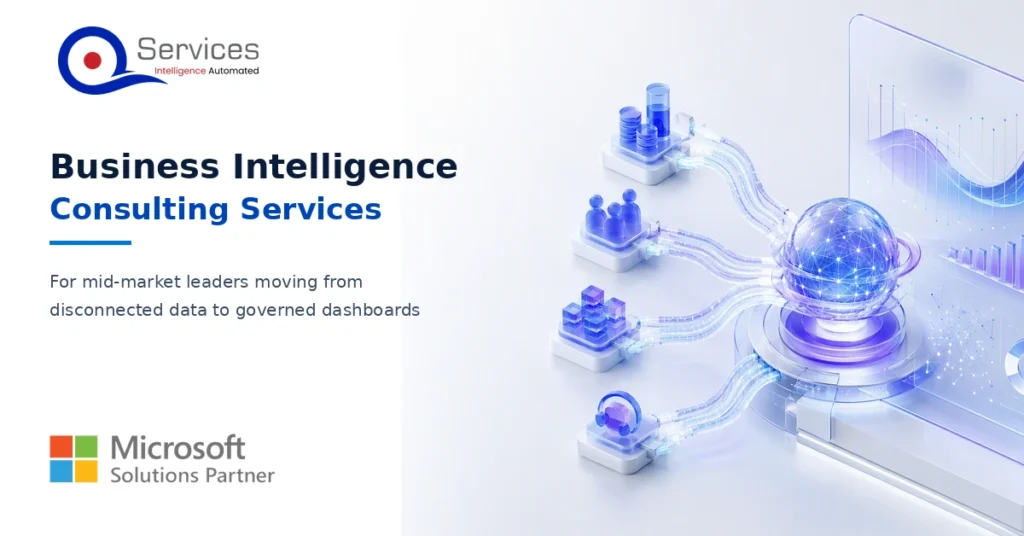
Business intelligence consulting services should give a mid-market company a governed way to make decisions. Attractive dashboards are only the visible part. The useful outcome is a system in which source data, metric definitions, access, releases, ownership, and support still work after the consultants leave.
In a Microsoft Solutions Partner vs Microsoft Partner comparison, the difference is validation. A company can participate in the Microsoft AI Cloud Partner Program without holding a customer-facing Solutions Partner designation. A designated Solutions Partner has met Microsoft’s current threshold in a specific solution pathway: at least 70 out of 100 partner capability points, with more than zero points in every required metric, based on performance, skilling, and customer success data recorded in Partner Center.
Business intelligence consulting services should give a mid-market company a governed way to make decisions. Attractive dashboards are only the visible part. The useful outcome is a system in which source data, metric definitions, access, releases, ownership, and support still work after the consultants leave.
In a Microsoft Solutions Partner vs Microsoft Partner comparison, the difference is validation. A company can participate in the Microsoft AI Cloud Partner Program without holding a customer-facing Solutions Partner designation. A designated Solutions Partner has met Microsoft’s current threshold in a specific solution pathway: at least 70 out of 100 partner capability points, with more than zero points in every required metric, based on performance, skilling, and customer success data recorded in Partner Center.